
Frequently asked questions
Find answers to common questions about GardenPal
Go to the "My Garden" tab and tap "Add new garden". Enter your location, name your garden, and add plants based on your preferences.
Go to Profile, open Account settings, and select Delete account. This will permanently remove your account and associated data.
To receive accurate suggestions, make sure you have entered your garden's location, as well as the light and soil conditions. The app uses this information to recommend plants that are best suited to your environment.
Currently, if you signed in with Google/Apple, your email is managed by Google/Apple. To use a different email, you will need to delete your account and create a new one using email sign-up.
We use global and national climate and solar data to estimate how much sun your garden gets and its hardiness zone. Wherever reliable data exists for your area, we show it straight away.
Full sun is a bright, open spot. Partial shade gets sun for part of the day. Full shade stays mostly out of direct sun.
In some places we can't estimate the light. When that happens we'll tell you and help you work it out yourself with a few quick questions. Anything you enter yourself always takes priority.
We use global and national climate and solar data to estimate how much sun your garden gets and its hardiness zone. RHS hardiness zones help you choose plants that will survive in your garden:
- A plant's RHS number shows how cold it can safely get before that plant is damaged or dies.
- A garden's RHS zone shows how cold it is likely to get in winter.
So for reliable survival, the plant's hardiness rating must be equal to or higher than your zone.
| RHS Zone | Temperature Range | Description |
|---|---|---|
| H1a | > 15°C | Heated greenhouse – tropical |
| H1b | 10°C to 15°C | Heated greenhouse – subtropical |
| H1c | 5°C to 10°C | Heated greenhouse – warm temperate |
| H2 | 1°C to 5°C | Tender – cool or frost-free greenhouse |
| H3 | -5°C to 1°C | Half hardy – unheated greenhouse/mild winter |
| H4 | -10°C to -5°C | Hardy – average winter |
| H5 | -15°C to -10°C | Hardy – cold winter |
| H6 | -20°C to -15°C | Hardy – very cold winter |
| H7 | < -20°C | Very hardy – coldest winter |
Example: If your garden is in RHS zone H4 (average winter, -10°C to -5°C), you should choose plants rated H4 or higher (H5, H6, H7) to ensure they survive your winter temperatures.
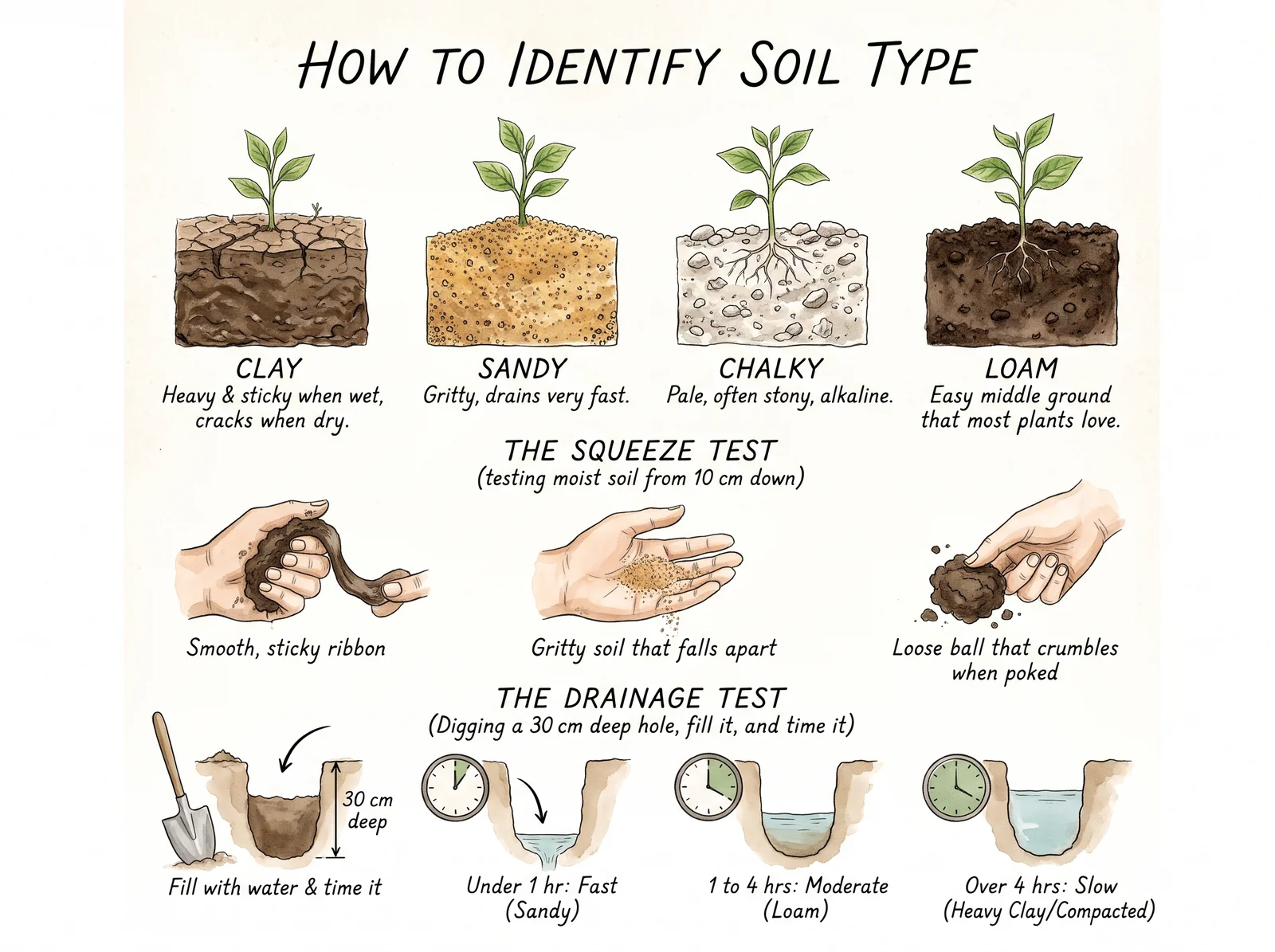
1. The Squeeze Test (Texture Test)
Take a small handful of moist soil from your garden (about 10 cm deep) and roll it between your fingers:
- Clay soil: Feels sticky when wet and forms a smooth, flexible ribbon that bends without breaking.
- Sandy soil: Feels gritty and falls apart easily when squeezed.
- Loamy soil: Feels soft and slightly moist, forming a crumbly ball that holds its shape but breaks gently when pressed.
- Chalky soil: Feels gritty and may contain small white stones; often slightly alkaline.
2. The Drainage Test
Dig a small hole (about 30 cm deep) and fill it with water:
- If the water drains within an hour, your soil is free-draining (likely sandy or chalky).
- If the water takes more than four hours, it is poorly draining (probably clay).
- Two to three hours suggests a well-balanced loam, ideal for most plants.
We use global and national soil and climate data to find your garden's soil type, pH and moisture. Wherever reliable data exists for your area, we show it straight away. In some places, often city centres, there isn't reliable soil data. When that happens we'll tell you and help you work it out yourself with a few quick questions. Anything you enter yourself always takes priority.
Data credits
- SoilGrids, ISRIC – World Soil Information: Shared under CC BY 4.0. SoilGrids, ISRIC – World Soil Information, CC BY 4.0
- SoilHive / Varda Foundation: SoilGrids readings are looked up through SoilHive. SoilHive
- Soil and Landscape Grid of Australia, CSIRO/TERN: Shared under CC BY 4.0. The values we show are derived and simplified from the original grid. About the grid, CC BY 4.0
- NASA POWER: The data was obtained from National Aeronautics and Space Administration (NASA) Langley Research Center's Prediction Of Worldwide Energy Resources (POWER) project funded through the NASA Earth Science Division. POWER Daily API v2.10.1, accessed 30 October 2026. NASA POWER, Referencing guide
- British Geological Survey: Contains British Geological Survey materials © UKRI 2026 Open Government Licence
- USDA NRCS Soil Survey: SSURGO and STATSGO2 are in the public domain. Credit the U.S. Department of Agriculture, Natural Resources Conservation Service. USDA NRCS
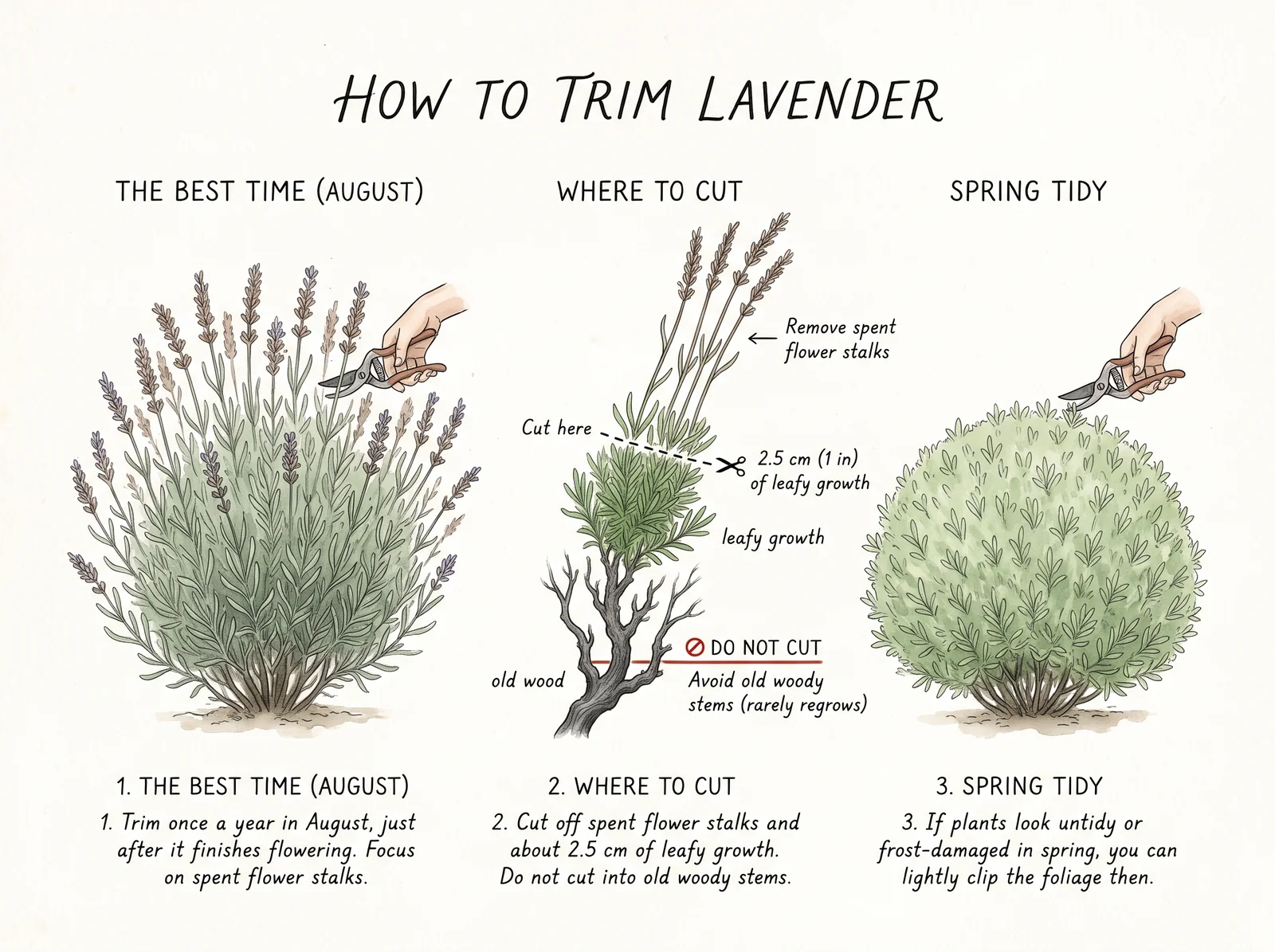
Trim lavender once a year in August, just after it finishes flowering. Cut off the spent flower stalks and about 2.5 cm of leafy growth, but don't cut into the old woody stems, because lavender rarely regrows from them. If plants look untidy or frost-damaged in spring, you can lightly clip the foliage then. Older plants become woody and straggly even with yearly trimming, so replace them every few years.
Many plants grow well on clay. It holds water and is rich in nutrients, so the key is choosing plants that cope with soil that sits wet in winter and can crack in summer. The RHS names its top five performers on clay as Mahonia, hydrangea, Sorbus aria 'Lutescens', hardy geraniums and Viburnum × bodnantense 'Dawn'. Our wet clay border uses Viburnum tinus 'Eve Price', tufted hair grass (Deschampsia cespitosa), Bergenia and bugle (Ajuga reptans) for evergreen structure. Meadow cranesbill, meadowsweet, ragged robin, bistort and devil's-bit scabious give the seasonal colour. Before planting, work in organic matter, and break up the bottom and sides of each planting hole so water can't collect there. Late winter or early spring is the best time to plant. To find more plants that suit wet clay, use the Garden Pal plant finder and filter by clay soil and wet or moist conditions.
Under a tree, plants have to cope with shade and dry soil, because the roots take the moisture and the canopy keeps off the rain. Work around the roots, not through them. Use hand tools only, and leave the ground right at the trunk alone. Don't pile extra soil evenly around the tree, because it compacts the ground and cuts off air to the roots. About a metre out from the trunk (more for a large or veteran tree), you can raise the soil by about 10 cm, tapering it down to nothing at that line. Plant small: plugs, small divisions or bulbs, never a big root ball. If you hit a root as thick as your finger or thicker, stop, refill the hole and move the plant somewhere else.
Fill five shapes: a compact rounded evergreen, a ground-hugging carpet, a woodland perennial, a fern or grass-like clump, and a small bulb. Under a deciduous tree, our dry shade guide uses Sarcococca, Geranium macrorrhizum, Heuchera, Liriope and wood anemone. Under a conifer the soil is dry and acidic, so choose plants that like those conditions, such as Skimmia, Vinca minor and Liriope. Plant in autumn, water well through the first growing season, and mulch each spring.
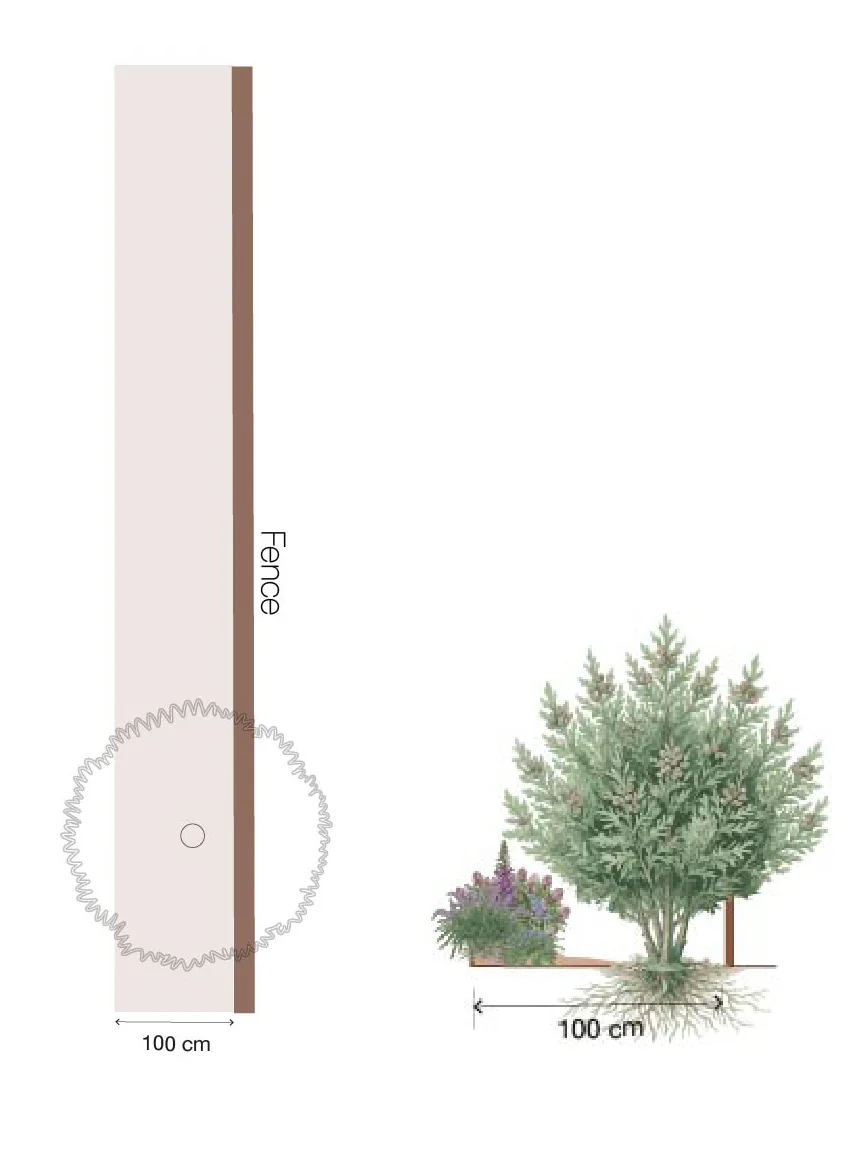
A spot can stay dry because the soil drains very freely, like sand, because the area gets little rain, or because it sits under trees, whose roots take the moisture and whose canopy keeps off the rain. It can also be shaded by a wall, a fence or a building. The best results come from choosing plants that suit the conditions you have, rather than trying to change the soil. So first work out why your spot is dry: is it the soil, the climate, or something blocking the rain?
Then enter your garden's conditions in the Garden Pal plant finder and filter by shade and well-drained or dry soil. You'll get plants that cope with your own spot. If your dry shade is under a tree, see our answer on planting under trees.
The best plants for pollinators have simple, open flowers with a single layer of petals, so bees and other insects can reach the pollen and nectar easily. Double or multi-petalled flowers usually offer much less food, because parts of the flower that would carry pollen and nectar have been turned into petals. Aim for flowers across as much of the year as you can, and plant in groups rather than single plants, because bees look for big patches of one flower.
Pollinator plants still need to suit your garden. Enter your garden's conditions in the Garden Pal plant finder and turn on the pollinator filter to see plants that will thrive in your spot. For an example, our Pollinator Drift Bed plants a 1.5 × 3 m sunny bed in drifts so that something is in flower in every month.
Partial shade means a spot that gets about 3 to 6 hours of direct sun a day, measured at midsummer. Full sun is more than 6 hours at midsummer, and anything less than 3 hours is shadier still. The timing matters too: midday sun gives much more light than morning or evening sun, and morning sun with afternoon shade is gentler than the other way round. A spot under a deciduous tree can also be sunny in April but shaded by June.
To check your spot, watch where the shadows fall at 9am, midday and 3pm on a sunny day in early summer. Or enter your garden's location in Garden Pal, and the plant finder works out your light and shows plants that suit it.
Full sun means more than 6 hours of direct sun a day. Always measure it in summer, ideally around midsummer, because the sun is much lower in winter and the same spot gets far less light. South-facing beds usually get full sun, and west-facing spots get the hottest, strongest light. Lavender, salvia, sedum and most ornamental grasses need full sun; in less light they grow leggy and flower poorly.
To find out how much sun your garden gets, enter its location in Garden Pal. The plant finder works out your light and shows plants for full sun or whatever light you have.
Most garden soils are clay, sandy, chalky or loam. Clay is heavy and sticky when wet and cracks when dry. Sandy soil is gritty and drains very fast. Chalky soil is pale, often stony and alkaline. Loam is the easy middle ground that most plants love.
The quickest way to find out is to enter your garden's location in Garden Pal. We use national and global soil maps to show your soil type, pH and moisture straight away. In some places, often city centres, there's no reliable soil data, so we'll help you work it out with a few quick questions.
You can also test it yourself. Squeeze test: take a handful of moist soil from about 10 cm down and squeeze it. A smooth, sticky ribbon means clay; gritty soil that falls apart means sand; a loose ball that crumbles when poked means loam. Drainage test: dig a hole about 30 cm deep, fill it with water and time it. Under an hour is fast, 1 to 4 hours is moderate, over 4 hours means heavy clay or compacted soil.
Then choose plants that suit your soil rather than trying to change it. The plant finder does this for you.
There's no fixed schedule like "once a week". How much water plants need depends on the weather, your soil, their size and how settled they are. Water less often but deeply, then let the surface dry before watering again.
In their first year, water regularly, even drought-tolerant plants: they need steady moisture in their first season to build deep roots. Water at the base until the soil is moist down to the roots, about 15 cm deep. Water early in the morning, at the base rather than over the leaves.
Once established, plants chosen to suit your spot need little or no watering, only help in long dry spells. Drooping leaves in the early morning are a sign they need a drink. Plants under trees, by walls or under eaves may need water even after rain.
Enter your conditions in the Garden Pal plant finder to choose plants that will cope with your spot once established.
Still have questions? Get in touch with support