
SD Landscapes · Garden Pal planting guide
The Pollinator Drift Bed: Flowers Every Month
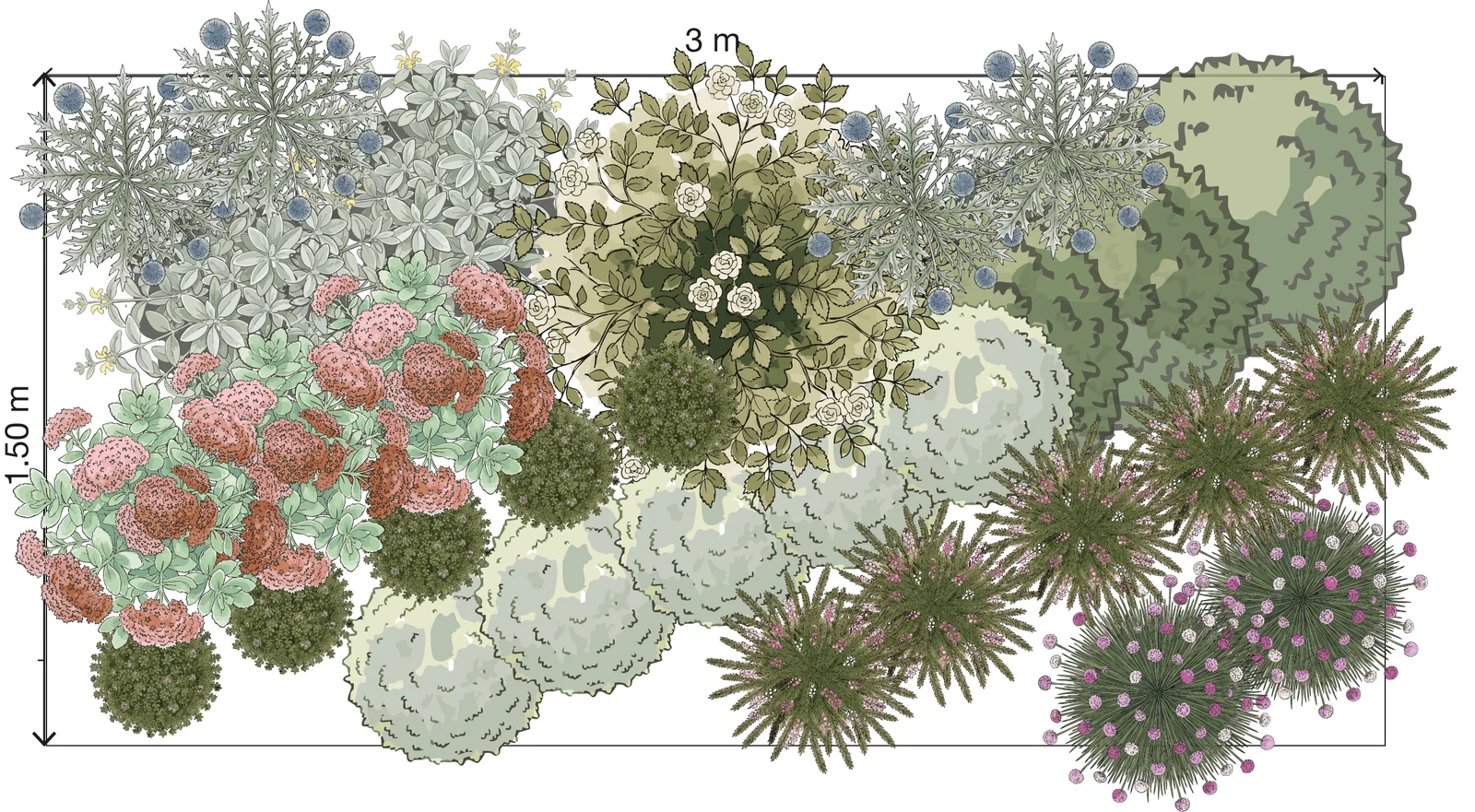
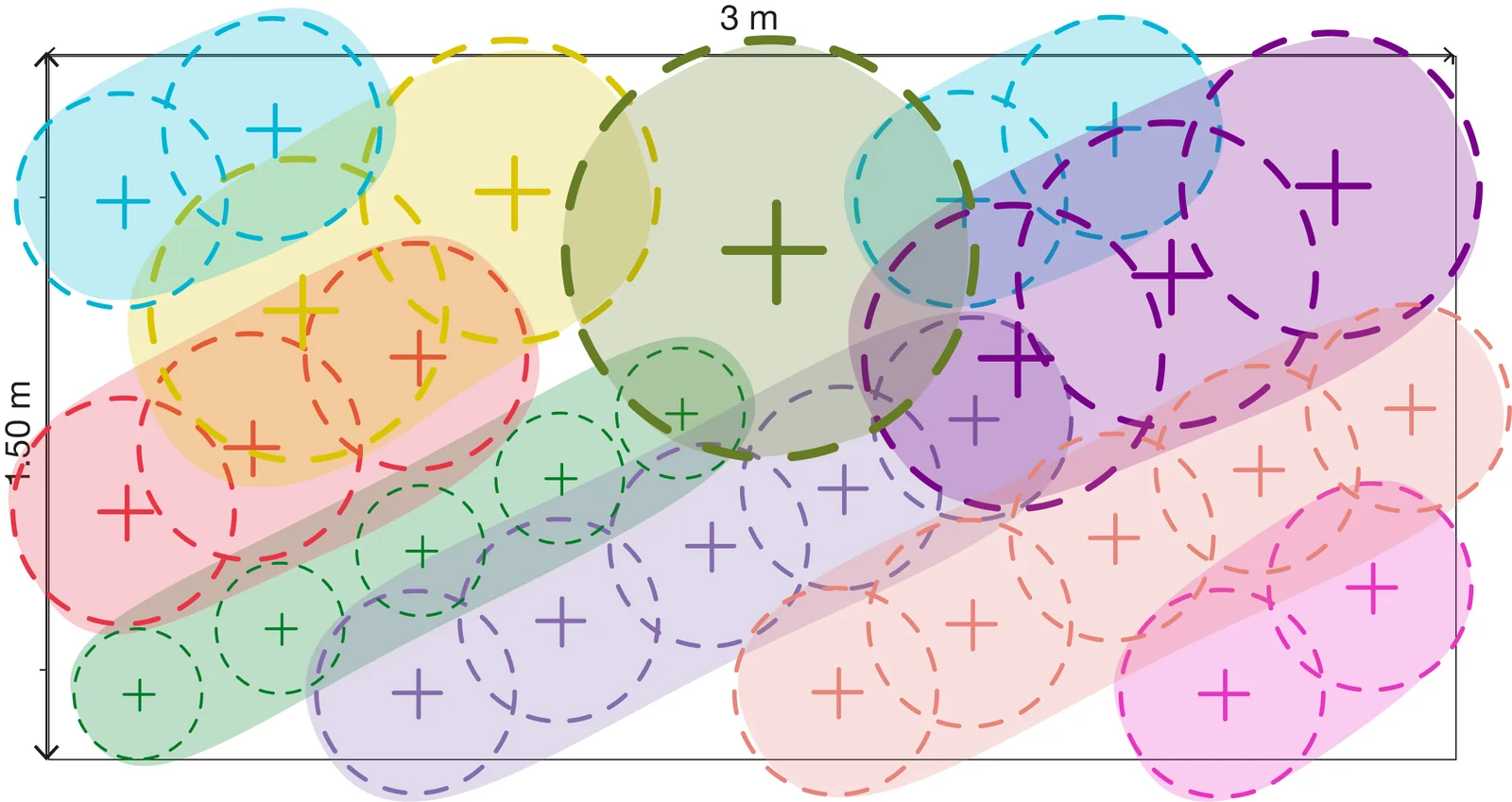
Stop dotting single plants. Bees look for big patches of one flower, so this bed is planted in drifts — long, slanted sweeps that flow into each other, like a classic English cottage garden. Your DRIFT guide — plant list from SD Landscapes (@sd.landscapes.studio).
Download the free illustrated plan (PDF)
Create a free Garden Pal account to save the illustrated plan to your phone.
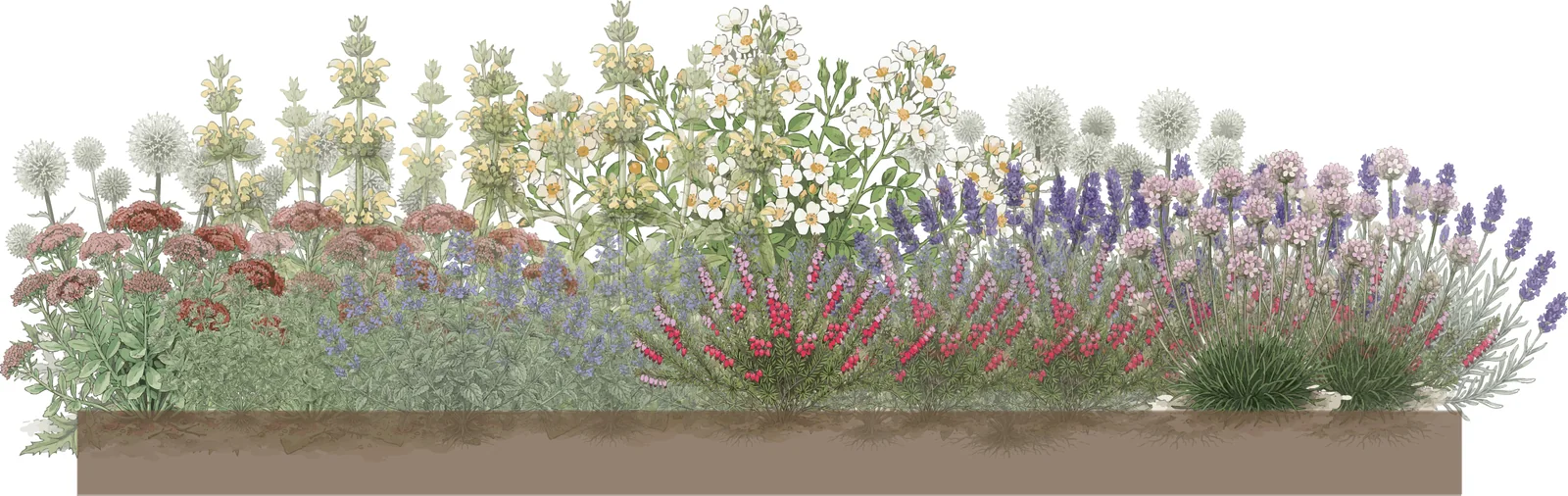
The bed
- The bed About 1.5 × 3 m, in full sun.
- The soil Well-drained — water soaks away after rain rather than sitting on the surface. Every plant here shares the same conditions (full sun, well-drained soil, per RHS), so nothing is fighting its neighbour.
Why drifts?
Bees forage big patches of one flower, so each plant is grouped into a drift rather than dotted singly. The drifts run as long sweeps at a slant of about 22.5° across the bed, overlapping and flowing into each other.
The plants
| Plant | Latin name | Evergreen / deciduous | Flowers | Height × spread | Planting gap | Qty |
|---|---|---|---|---|---|---|
| Rose 'Kew Gardens' | Rosa 'Ausfence' | Deciduous | Jun–Nov | 1.5 × 1 m | 1 m | 1 |
| Turkish sage | Phlomis russeliana | Deciduous | May–Nov | 0.9 × 0.75 m | 0.75 m | 2 |
| Globe thistle 'Arctic Glow' | Echinops sphaerocephalus 'Arctic Glow' | Deciduous | Aug–Sep | 1 × 0.1–0.5 m* | up to 0.5 m* | 4 |
| Autumn Joy sedum | Hylotelephium 'Herbstfreude' | Deciduous | Aug–Sep | 0.6 × 0.6 m | 0.6 m | 3 |
| Lesser calamint | Calamintha nepeta | Semi-evergreen | Jun–Sep | 0.6 × 0.5–1 m* | 0.5 m* | 5 |
| Lavender 'Hidcote' | Lavandula angustifolia 'Hidcote' | Evergreen | Jun–Sep | 0.75 × 0.6 m | 0.6 m | 3 |
| Winter heather 'Springwood White' | Erica carnea f. alba 'Springwood White' | Evergreen | Dec–May | 0.2 × 0.45 m | 0.45 m | 5 |
| Thrift | Armeria maritima | Evergreen | May–Jul | 0.5 × 0.5 m | 0.5 m | 2 |
| Compact marjoram | Origanum vulgare 'Compactum' | Deciduous | Jul–Sep | 0.15 × 0.3 m | 0.3 m | 5 |
Rose 'Kew Gardens'
- Latin name
- Rosa 'Ausfence'
- Evergreen / deciduous
- Deciduous
- Flowers
- Jun–Nov
- Height × spread
- 1.5 × 1 m
- Planting gap
- 1 m
- Qty
- 1
Turkish sage
- Latin name
- Phlomis russeliana
- Evergreen / deciduous
- Deciduous
- Flowers
- May–Nov
- Height × spread
- 0.9 × 0.75 m
- Planting gap
- 0.75 m
- Qty
- 2
Globe thistle 'Arctic Glow'
- Latin name
- Echinops sphaerocephalus 'Arctic Glow'
- Evergreen / deciduous
- Deciduous
- Flowers
- Aug–Sep
- Height × spread
- 1 × 0.1–0.5 m*
- Planting gap
- up to 0.5 m*
- Qty
- 4
Autumn Joy sedum
- Latin name
- Hylotelephium 'Herbstfreude'
- Evergreen / deciduous
- Deciduous
- Flowers
- Aug–Sep
- Height × spread
- 0.6 × 0.6 m
- Planting gap
- 0.6 m
- Qty
- 3
Lesser calamint
- Latin name
- Calamintha nepeta
- Evergreen / deciduous
- Semi-evergreen
- Flowers
- Jun–Sep
- Height × spread
- 0.6 × 0.5–1 m*
- Planting gap
- 0.5 m*
- Qty
- 5
Lavender 'Hidcote'
- Latin name
- Lavandula angustifolia 'Hidcote'
- Evergreen / deciduous
- Evergreen
- Flowers
- Jun–Sep
- Height × spread
- 0.75 × 0.6 m
- Planting gap
- 0.6 m
- Qty
- 3
Winter heather 'Springwood White'
- Latin name
- Erica carnea f. alba 'Springwood White'
- Evergreen / deciduous
- Evergreen
- Flowers
- Dec–May
- Height × spread
- 0.2 × 0.45 m
- Planting gap
- 0.45 m
- Qty
- 5
Thrift
- Latin name
- Armeria maritima
- Evergreen / deciduous
- Evergreen
- Flowers
- May–Jul
- Height × spread
- 0.5 × 0.5 m
- Planting gap
- 0.5 m
- Qty
- 2
Compact marjoram
- Latin name
- Origanum vulgare 'Compactum'
- Evergreen / deciduous
- Deciduous
- Flowers
- Jul–Sep
- Height × spread
- 0.15 × 0.3 m
- Planting gap
- 0.3 m
- Qty
- 5
Planting gap = the plant's full mature spread, measured centre to centre. Total 30 plants. *RHS gives a size range: globe thistle 'Arctic Glow' max spread 0.1–0.5 m (height to 1 m); lesser calamint to 60 cm tall, max spread 0.5–1 m.
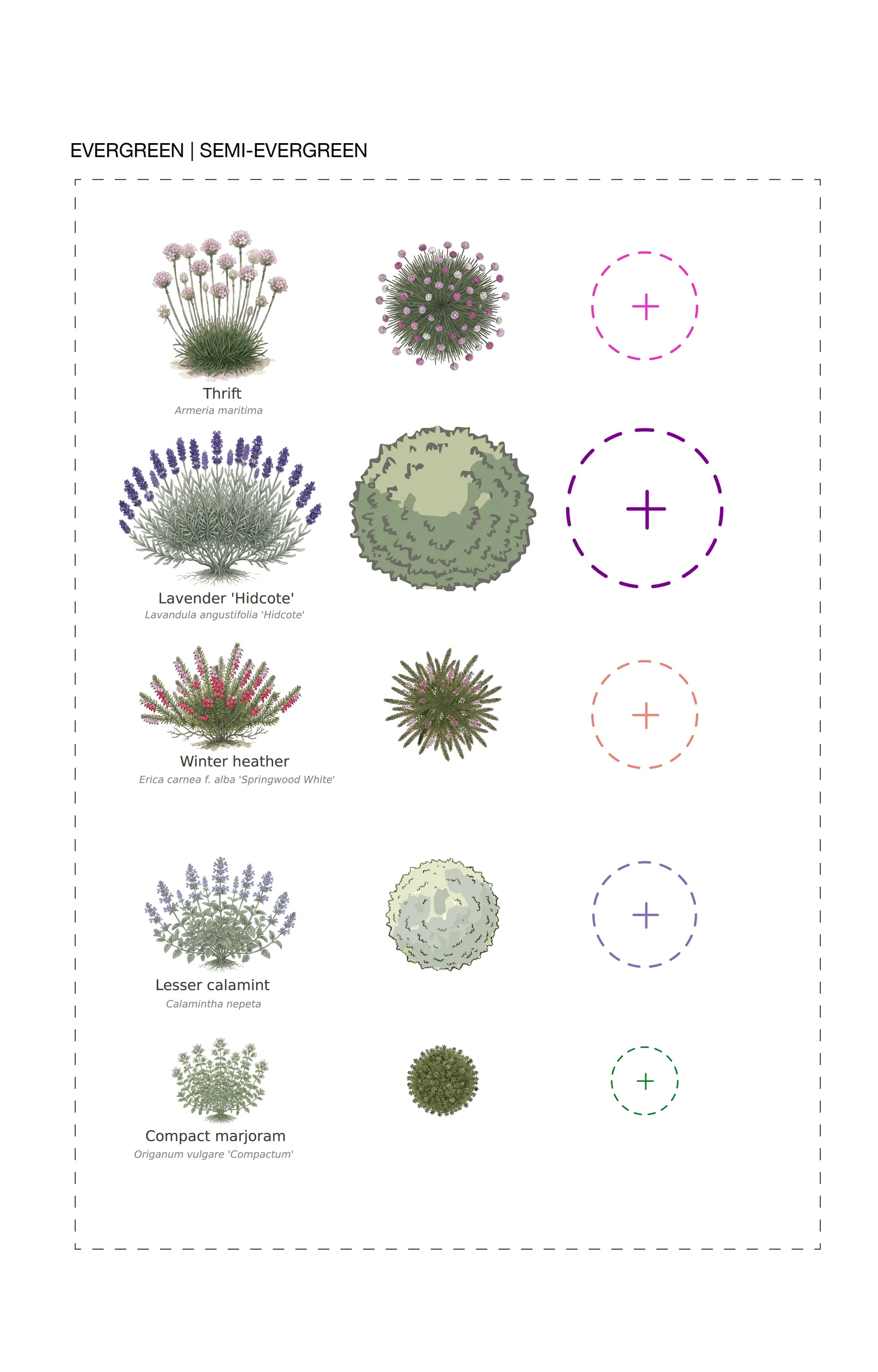
Evergreen and semi-evergreen
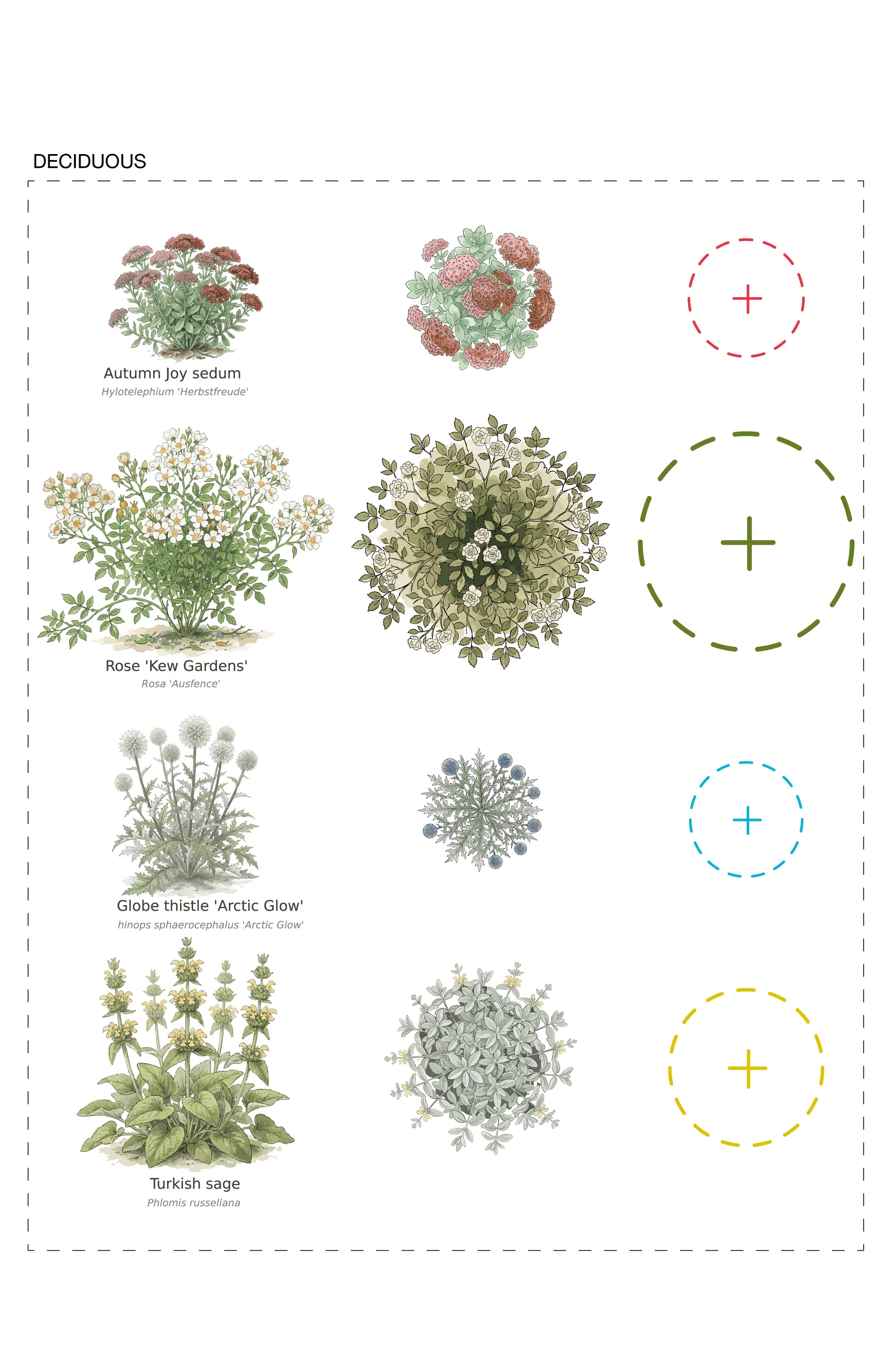
Deciduous
Flowers every month
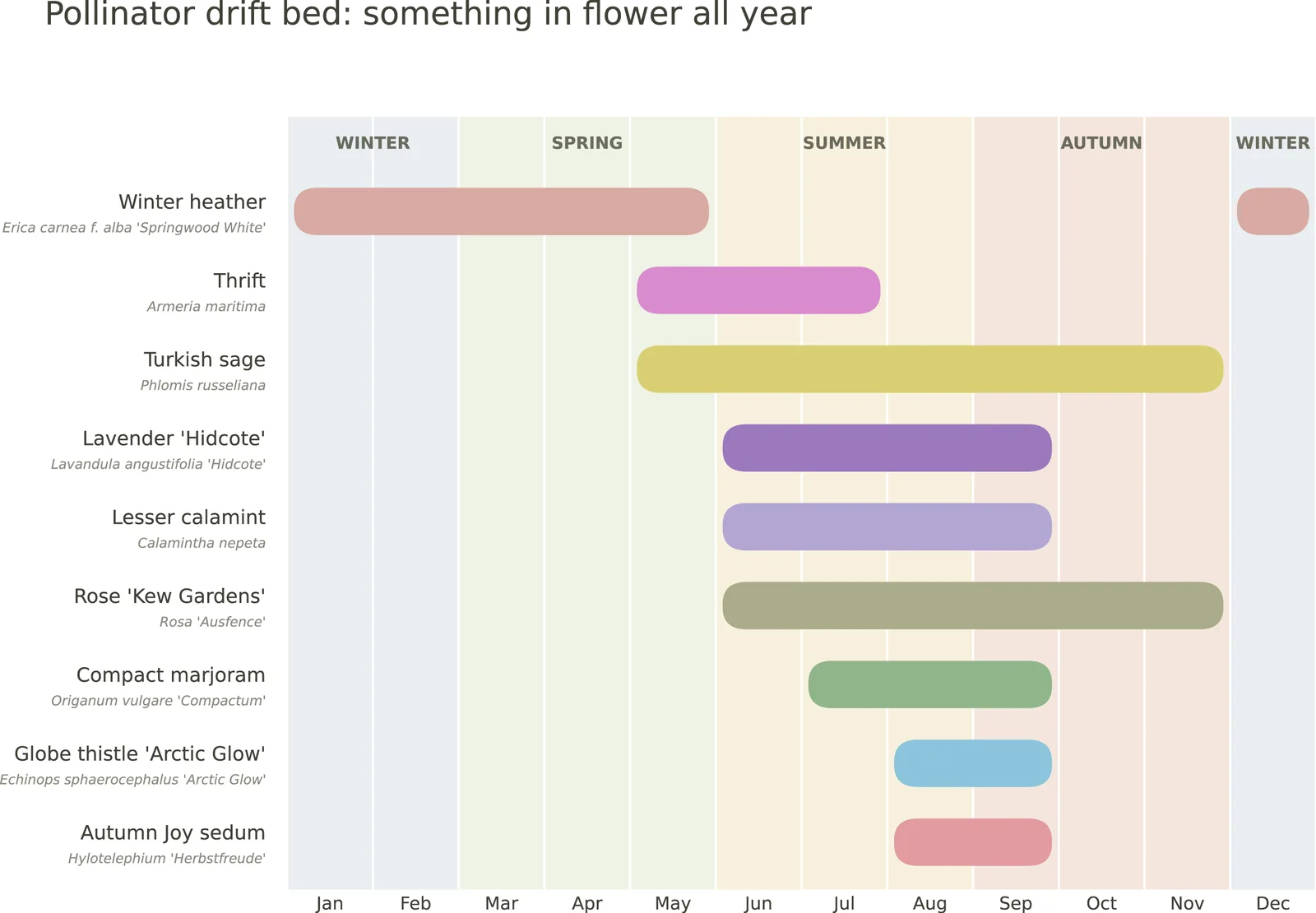
- Dec–May: winter heather feeds early bees.
- May–Jul: thrift and Turkish sage join in.
- Jun–Sep: rose, lavender and lesser calamint; marjoram from Jul.
- Aug–Sep: globe thistle and Autumn Joy sedum.
- Oct–Nov: rose 'Kew Gardens' and Turkish sage carry it to November.
Winter structure
Evergreen lavender, heather and thrift (and semi-evergreen calamint) keep the bed's shape, so it never disappears. Turkish sage seedheads stand through winter, the rose has small red hips, and the old sedum heads give shelter to ladybirds.
How to plant the drifts
- Mark out the long slanted sweeps on the soil first (sand or a cane works well), following the drift diagram at about 22.5°.
- Set out each plant in its pot along its drift before planting, checking the spacing.
- Plant tallest plants (rose, Turkish sage, globe thistle) towards the back, low ones (heather, thrift, marjoram) at the front.
- Plant at the same depth as the pot and water in well.
Simple care
Rose 'Kew Gardens'
Jun–Sep: snip off fading flowers about once a week, down to just above the next leaf, to keep it flowering. Leave the last flowers on so they can form the small red hips for winter.
Feb–Mar: prune when growth is just starting (mid-February in the south, March in colder areas). Shorten the strong new growth by up to a third and strong sideshoots to two or three buds. On mature plants, cut one or two of the oldest stems back to the base. Remove dead, damaged and crossing stems.
Lavender 'Hidcote'
Aug–Sep, just after flowering: trim off the spent flower stalks and about 2.5 cm of the leafy growth to keep plants compact. Never cut back into the old, bare woody stems. In cold or wet areas, don't trim in Oct–Nov.
Apr: lightly clip over any growth that is untidy or frost-damaged.
Autumn Joy sedum
Late May: optional "Chelsea chop": cut the stems back by up to half for sturdier, more compact plants that don't flop.
Oct–Feb: leave the dead stems and flower heads standing for winter structure.
Mar–Apr: cut old stems to the ground as the new growth appears.
Turkish sage
Jul–Nov: don't deadhead, because the seedheads are part of the display and stand right through winter.
Mar–Apr: cut back the old stems to tidy the plant and contain it, and remove any frost-damaged or weak stems.
Water new plants through their first summer while they establish. After that the bed needs watering only in long dry spells.
Sources and notes
Before you plant
Plants in this guide are selected for UK conditions. Outside the UK? Check plants against your local invasive species list before planting. Planting plans and quantities are indicative only. Check your own site's light and drainage before buying, and adjust quantities to the size of your bed.
Plan and illustrations: SD Landscapes / @sd.landscapes.studio. For support send an email: support@garden-pal.com
Find plants like these for your own soil and light
Free to start. Add your garden and Garden Pal matches plants to your soil, light, and climate.
Planting advice here is written for UK conditions. Some of these plants are invasive or weedy in other countries, so check your local invasive plant list before planting.
Find plants like these for your own soil and light
Free to start. Add your garden and Garden Pal matches plants to your soil, light, and climate.
Download the free illustrated plan (PDF)
Create a free Garden Pal account to save the illustrated plan to your phone.