
Planting a Heavy Clay Border That Sits Wet
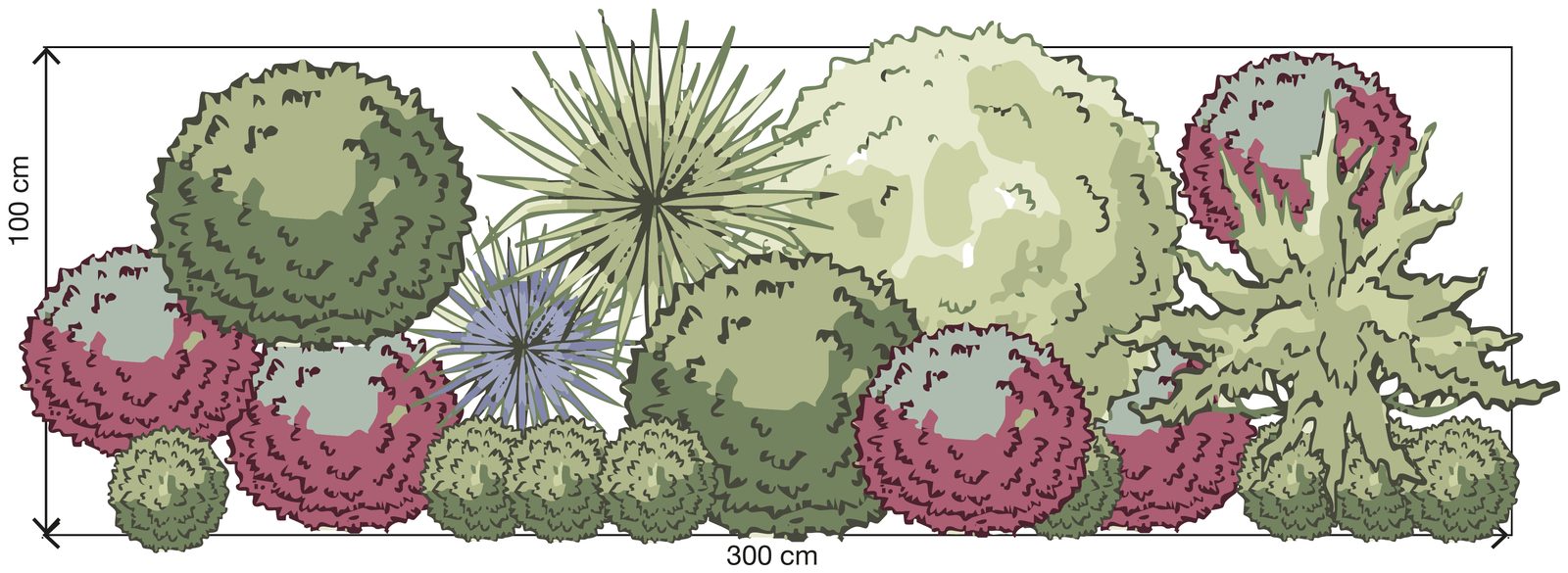
Heavy clay soil is challenging but fertile. It holds water in winter (sometimes sitting wet for weeks), then cracks hard in summer drought. This isn't a true bog—it's the seasonal wet-dry cycle typical of many UK gardens. This guide covers a practical planting plan for a small border (~1m × 3m) in these conditions. Plant list adapted from SD Landscapes (@sd.landscapes.studio).
Recognising heavy clay
Heavy clay needs a different plant palette than free-draining soil. Here's how to confirm you have clay:
- The squeeze test Take a handful of moist soil from about 10cm deep and squeeze it. If it feels sticky, smooth, and forms a ribbon that bends without breaking, you have clay.
- Winter waterlogging Puddles sit on the surface for hours or days after rain. The soil squelches underfoot in wet weather.
- Summer cracking In dry spells, the surface develops visible cracks as the clay shrinks.
Not sure about your soil?
Gritty and falls apart = sandy (use our dry bed guide instead). Sticky and smooth = clay (this guide). Forms a loose ball that crumbles gently when poked = loam (either guide may work depending on drainage).
Evergreen structure: five shapes
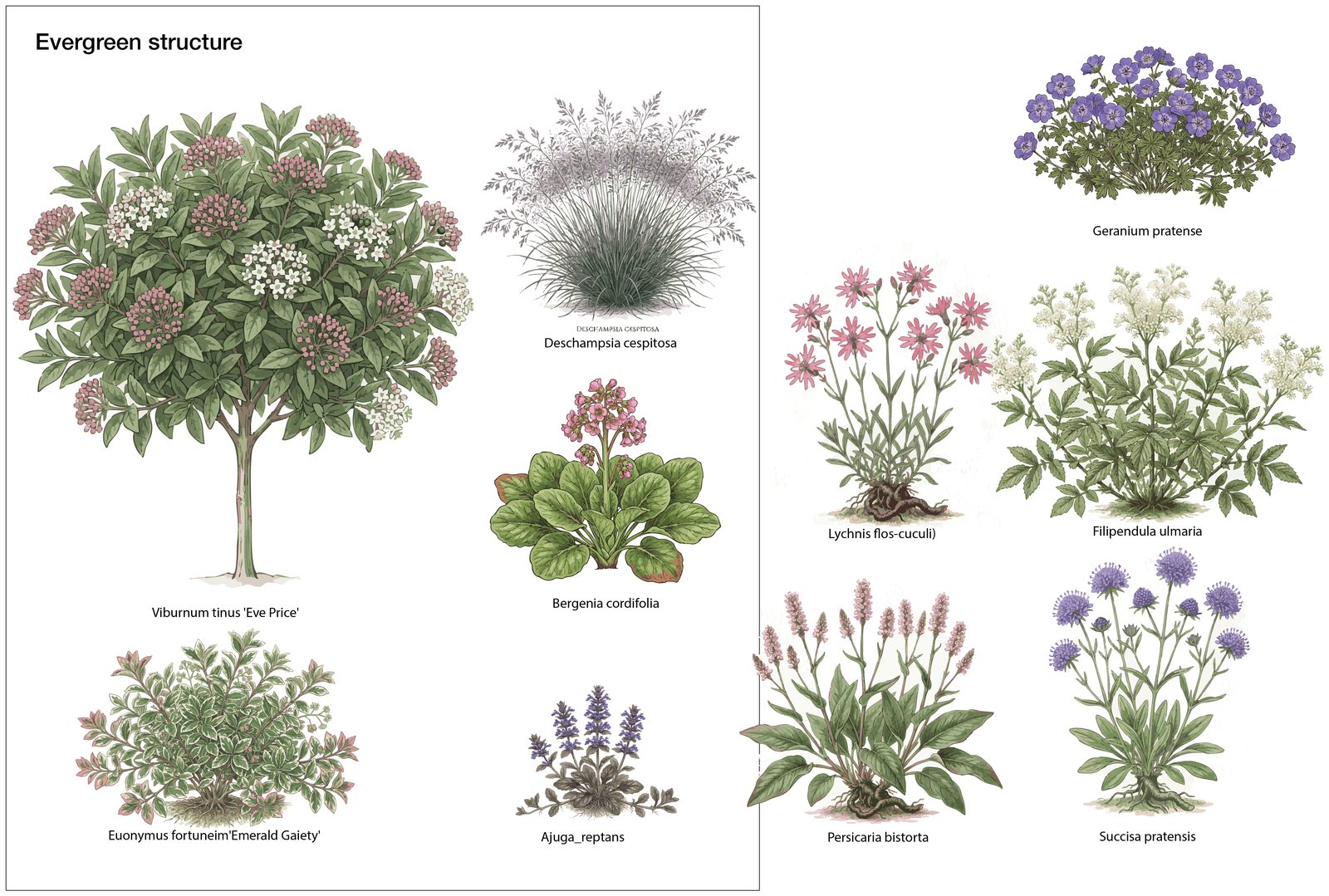
The same five-shape approach works for clay, but with different plants that tolerate wet roots. Note that mature sizes are larger for some clay-tolerant shrubs—scale quantities to your space.
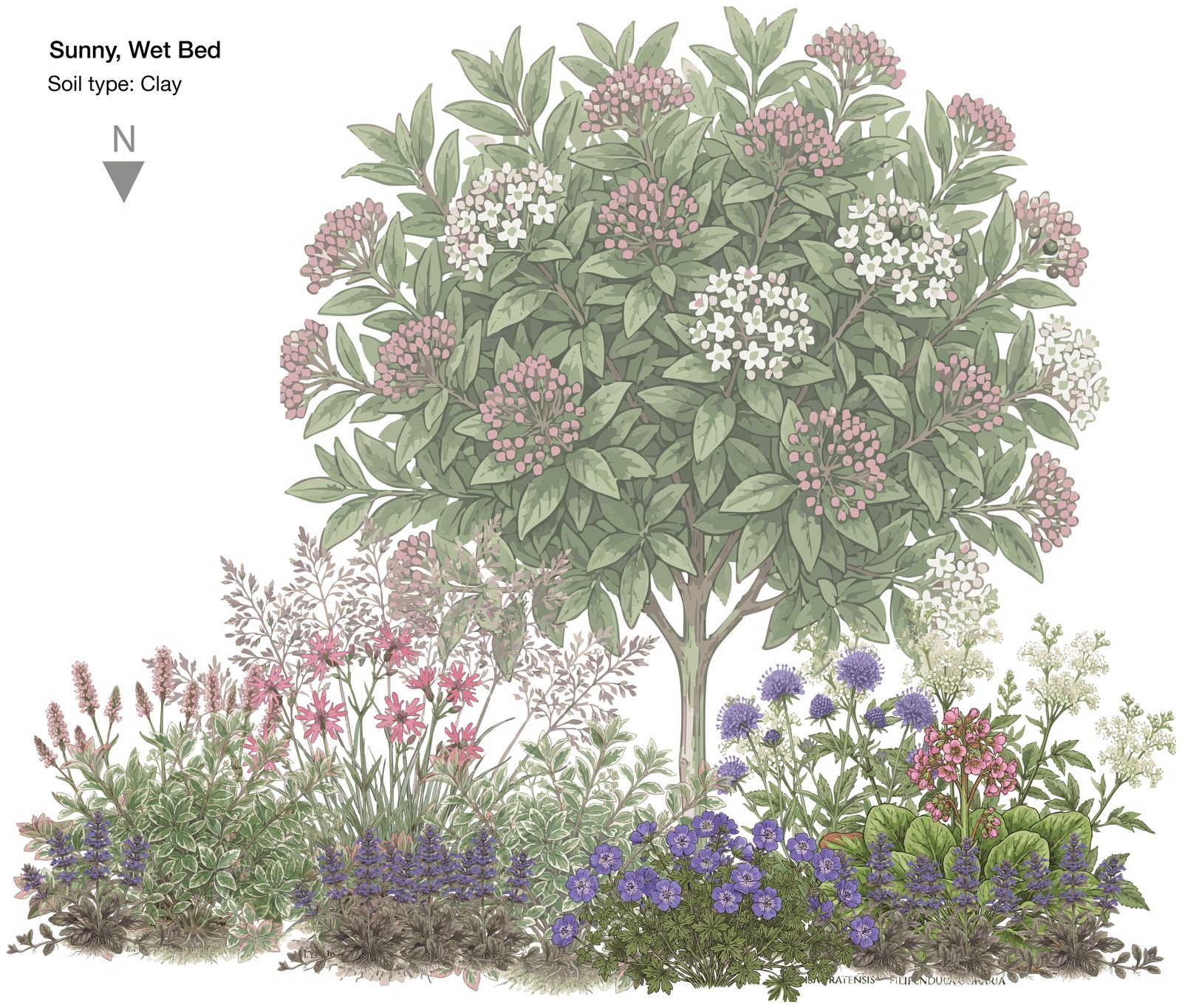
- Viburnum tinus 'Eve Price' — clear stem/standard (tall round focal) Qty 1. Mature size 1.5–2.5m × 1.5–2.5m. Note: this is large for a 3m bed—consider placing at the back corner or training as a lollipop standard. Source: garden centre.
- Deschampsia cespitosa (grass-like) Qty 1–2. Space ~50cm apart if planting 2. Flower spikes reach 1–1.5m × 0.5–1m spread. Elegant tufted hair grass. Source: garden centre.
- Bergenia cordifolia (architectural mound) Qty 1. Mature size 0.5–1m × 0.5–1m. Bold evergreen leaves that turn bronze in winter, pink flowers in spring. Source: garden centre.
- Ajuga reptans (groundcover) Qty 3–4. Space ~40–50cm apart along the front of the bed. Mature size 0.1–0.5m × 0.5–1m spread. Bronze-purple leaves with blue flower spikes. Source: garden centre.
Short round options
For the fifth shape (short round), you have two options depending on space:
- Option A: Euonymus fortunei 'Emerald Gaiety' Qty 1. Generous spread 0.5–1m × 1–1.5m. Variegated evergreen with pink winter tints. Source: garden centre.
- Option B: Skimmia japonica 'Bowles's Dwarf Female' (better size fit) Qty 2–3. Space ~35–40cm apart. Compact size 0.15m × 0.45m. Red berries if a male Skimmia is nearby. Source: specialist nursery.
Seasonal layer for clay
Choose 3–4 species from this list for a ~3m² bed. Plant in groups of 3–5. These plants tolerate the wet-winter/dry-summer cycle of clay—this is not a true bog plant list.
- Meadowsweet / Filipendula ulmaria Qty 3–5. Frothy cream flower heads, loves damp ground. Source: specialist nursery.
- Common bistort / Persicaria bistorta Qty 3–5. Pink poker flowers in early summer. Source: garden centre.
- Meadow cranesbill / Geranium pratense Qty 3–5. Blue flowers throughout summer. Source: garden centre.
- Ragged robin / Silene flos-cuculi Qty 3–5. Delicate pink shredded petals. Source: specialist nursery.
- Devil's-bit scabious / Succisa pratensis Qty 3. Purple pincushion flowers, late-season pollinator plant. Note: sourcing not confirmed for all nurseries—check availability. Source: specialist nursery (may need searching).
Honest sizing note
Mature size and spacing for the seasonal layer plants are based on typical ranges but not all are fully RHS-confirmed for this specific scheme. Start with generous spacing (~30–40cm) and adjust as plants establish.
Planting tips for clay
- Plant in autumn or early spring when soil is moist but not waterlogged—avoid working wet clay as it compacts.
- Dig planting holes wider than deep and roughen the sides to prevent "clay pot" effect where roots circle.
- Add grit to planting holes for shrubs if drainage is very poor, but don't create a sump that fills with water.
- Mulch with organic matter in autumn—clay benefits from surface organic material breaking down over time.