
Planting a Full-Sun Dry Bed Border
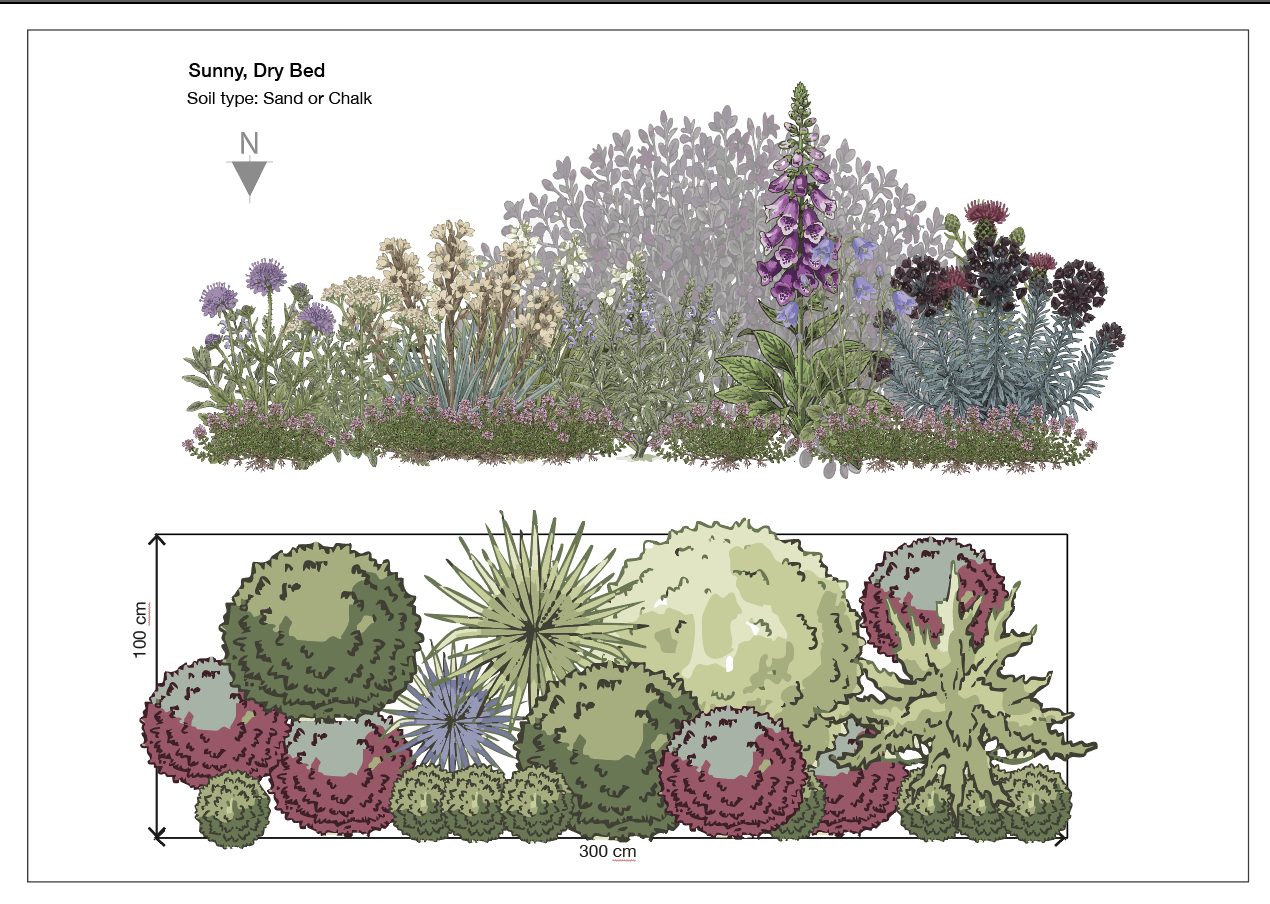
Dry, free-draining beds in full sun suit Mediterranean-style planting and drought-tolerant perennials. This guide covers a practical planting plan for a small border (~1m × 3m) in a south- or west-facing spot with sandy or chalky soil that drains quickly. Plant list adapted from SD Landscapes (@sd.landscapes.studio).
Check your conditions first
This planting plan works best when your bed matches these conditions:
- Full sun At least 6 hours of direct sunlight, typically south- or west-facing. Track shadows at 9am, midday, and 3pm to confirm.
- Free-draining soil Sandy or chalky soil that doesn't hold water. The squeeze test: if a handful of moist soil feels gritty and falls apart when you open your hand, it's sandy. If it's pale with visible white flecks, it's chalky.
The squeeze test
Take a handful of moist soil from about 10cm deep and squeeze it. Gritty and falls apart = sandy (this guide). Sticky and smooth = clay (use our waterlogged clay guide instead). Forms a loose ball that crumbles gently = loam (either guide may work).
Evergreen structure: five shapes
Start with evergreen plants that give year-round structure. The five-shape approach creates visual interest through contrasting forms: tall round focal point, grass-like, architectural mound, groundcover, and short round.
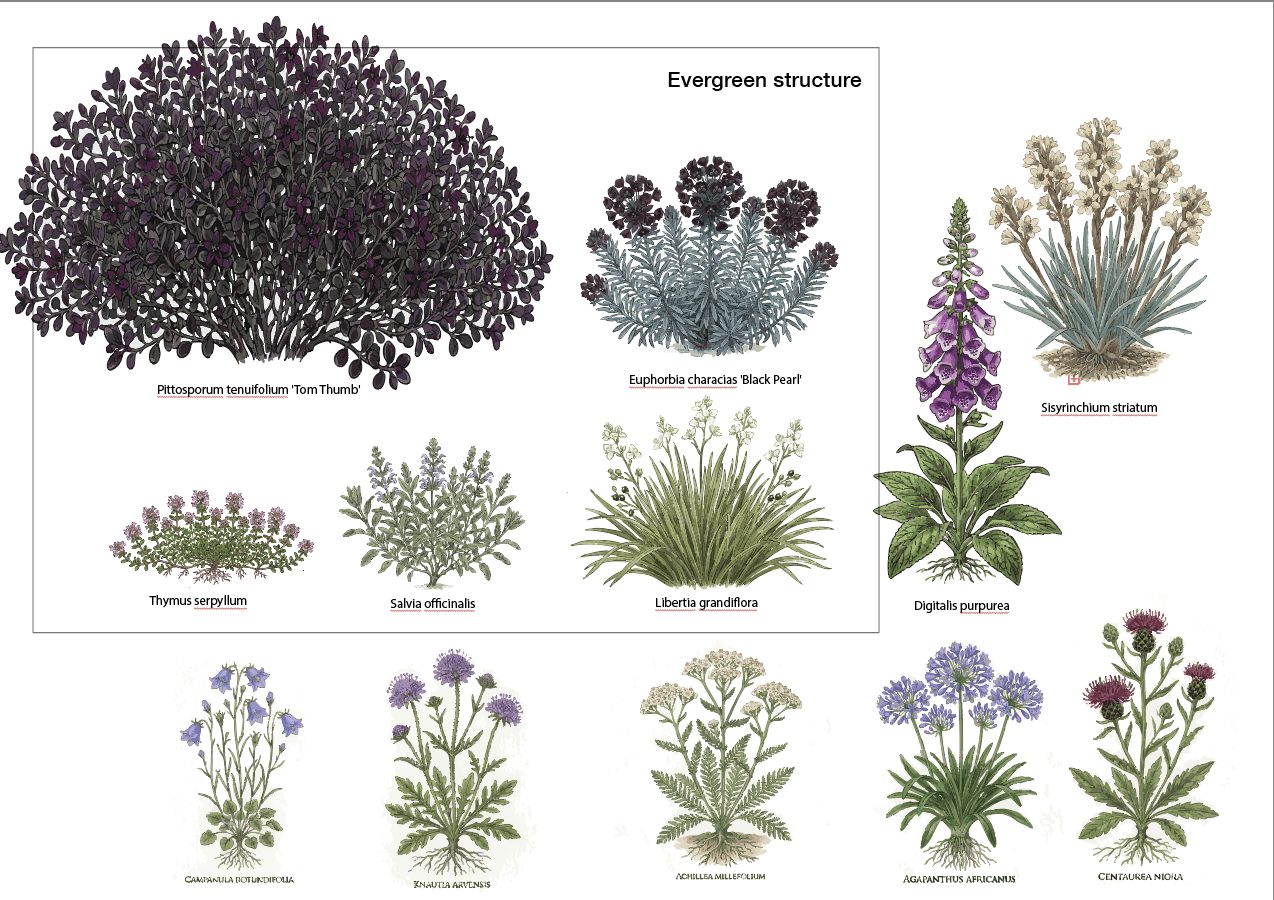
- Pittosporum tenuifolium 'Tom Thumb' (tall round focal) Qty 1. Mature size 0.5–1m × 0.5–1m. This is the centrepiece of the bed—position it first. Source: garden centre.
- Libertia grandiflora (grass-like) Qty 1–2. If planting 2, space ~50cm apart. Mature size 0.5–1m × 0.5–1m. Source: garden centre.
- Euphorbia characias 'Black Pearl' (architectural mound) Qty 1. Mature size 0.5–1m × 0.5–1m. Striking lime-green flower heads in spring. Source: garden centre.
- Wild thyme / Thymus serpyllum (groundcover) Qty 4–5. Space ~25–30cm apart along the front edge of the bed. Mature size up to 10cm × 0.1–0.5m spread. Source: specialist nursery.
- Sage / Salvia officinalis (short round) Qty 2–3. Space ~40–50cm apart. Mature size 0.5–1m × 0.5–1m. Culinary herb that doubles as ornamental structure. Source: garden centre.
Seasonal and pollinator layer
For a ~3m² bed, choose 3–4 species from this list rather than all of them. Plant each in groups of 3–5 for natural-looking drifts rather than scattered singles.
- Yarrow / Achillea millefolium Qty 3–5. Space ~30cm apart. Mature size 0.5–1m × 0.1–0.5m. Flat flower heads loved by pollinators. Source: garden centre.
- Common knapweed / Centaurea nigra Qty 3–5. Space ~25cm apart. Native wildflower, excellent for bees. Source: specialist nursery.
- Field scabious / Knautia arvensis Qty 3. Space ~30cm apart. Mature size 1–1.5m tall. Soft blue pincushion flowers. Source: specialist nursery.
- Harebell / Campanula rotundifolia Qty 5. Space ~20cm apart. Delicate native bellflower. Source: specialist nursery.
- Foxglove / Digitalis purpurea Qty 2–3. Space ~30cm apart. Mature size 1.5–2.5m tall. Biennial accent—don't overdo as they self-seed freely. Source: garden centre.
Alternative choices and swaps
- Agapanthus africanus Qty 3. Dramatic blue flower heads in late summer. Needs winter protection in cold areas.
- Sisyrinchium striatum Qty 3–5. Sword-like leaves with pale yellow flower spikes.
- Bird's-foot trefoil / Lotus corniculatus Qty 5. Native wildflower, low-growing. Source: specialist nursery.
Planting tips for dry beds
- Water well at planting and during the first summer while roots establish. Once settled, these plants rarely need watering.
- Avoid adding too much organic matter—many drought-tolerant plants prefer lean soil.
- Gravel mulch helps suppress weeds and reflects light, mimicking Mediterranean conditions.
- Plant in autumn if possible—cooler, wetter months help roots establish before summer drought.