
The Full-Sun Formula: Three Plants, Repeated
Three plants, repeated. That's the whole formula. A bed about 1×3m in full sun (at least six hours of direct light), with well-drained soil. One shape for winter, one for the wind, one for summer—cushion, fountain, and float. The shapes stay the same wherever you garden; only the plants change. This guide covers UK and Australian native versions of the same design. Plant list adapted from SD Landscapes (@sd.landscapes.studio).
Check your conditions first
This planting plan works for a bed about 1×3m in full sun with well-drained soil. Full sun means a good six hours of direct light—usually a south- or west-facing bed with nothing (a fence, wall, or tree) blocking it for most of the day.
- Full sun At least 6 hours of direct sunlight per day. Track shadows at 9am, midday, and 3pm to confirm your bed qualifies.
- Well-drained soil Water soaks away after rain rather than sitting on the surface. Sandy, chalky, or loamy soil typically drains well.
Heavy clay drainage
Lavender won't cope with heavy, waterlogged clay. If your drainage is poor, the RHS suggests planting on a 20–30cm mound, ridge, or raised bed to improve conditions.
The three shapes
Every plant in this formula shares the same conditions—full sun and well-drained soil—so nothing is fighting its neighbour. The formula relies on three contrasting shapes that work together:
- The cushion Low, rounded, evergreen. Covers the ground and holds the bed together in winter. Plant many, close together, in groups.
- The fountain Grass-like and arching. Catches the wind and gives the bed its rhythm. Plant a few, spaced unevenly through the middle.
- The float Tall, airy, see-through. Provides seasonal colour and attracts pollinators. Scatter through as drifts in the gaps.
One shape for winter, one for the wind, one for summer. The shapes stay the same wherever you garden; only the plants change. That's why there are two plant lists below: one for the UK, one for Australia.
UK planting plan
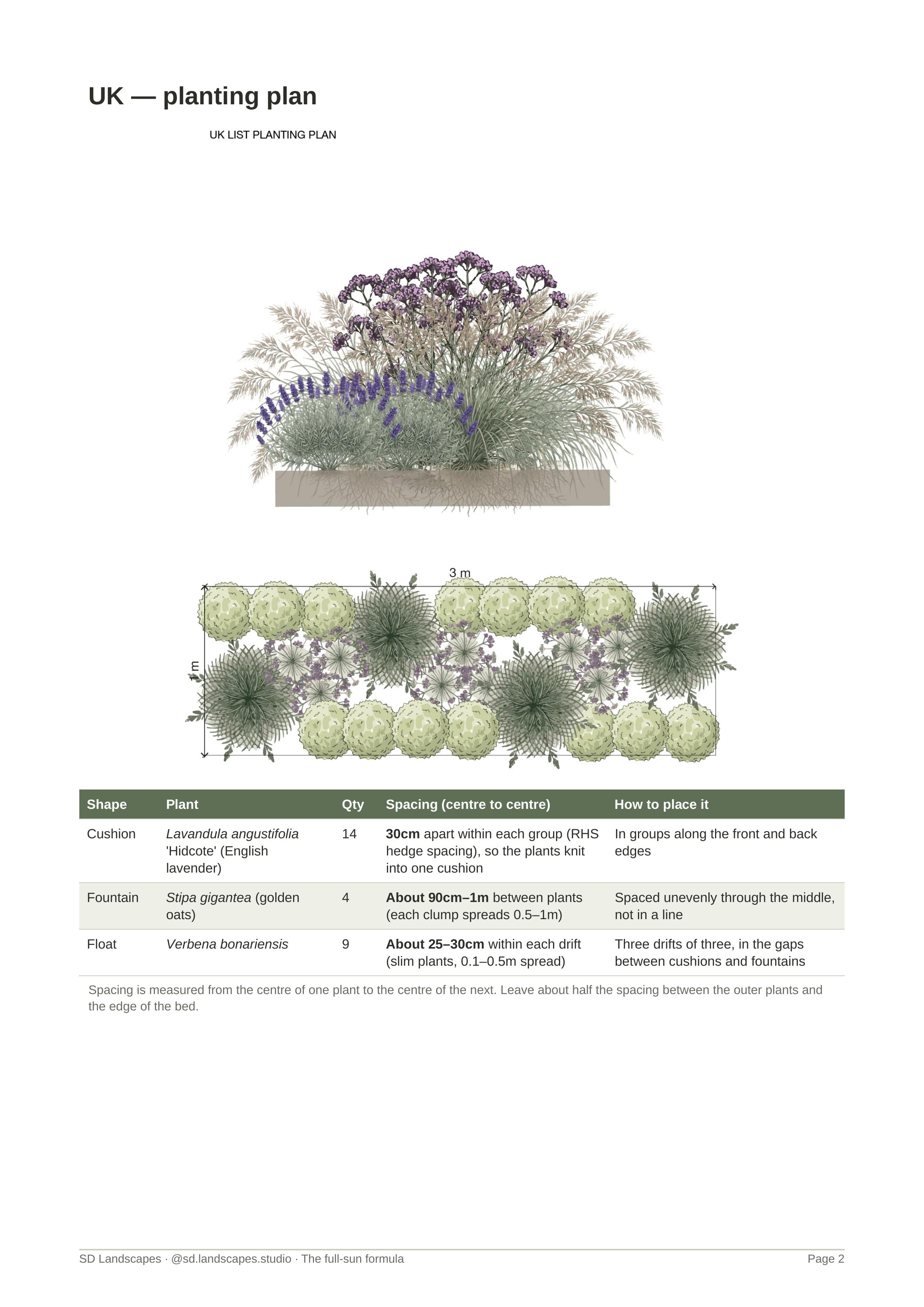
UK plant list
- Cushion: Lavandula angustifolia 'Hidcote' (English lavender) Qty 14. Space 30cm apart within each group (RHS hedge spacing) so the plants knit into one cushion. Position in groups along the front and back edges.
- Fountain: Stipa gigantea (golden oats) Qty 4. Space about 90cm–1m between plants (each clump spreads 0.5–1m). Position unevenly through the middle, not in a line.
- Float: Verbena bonariensis Qty 9. Space about 25–30cm within each drift (slim plants with 0.1–0.5m spread). Plant as three drifts of three, in the gaps between cushions and fountains.
Spacing note
Spacing is measured from the centre of one plant to the centre of the next. Leave about half the spacing between the outer plants and the edge of the bed.
UK plant details
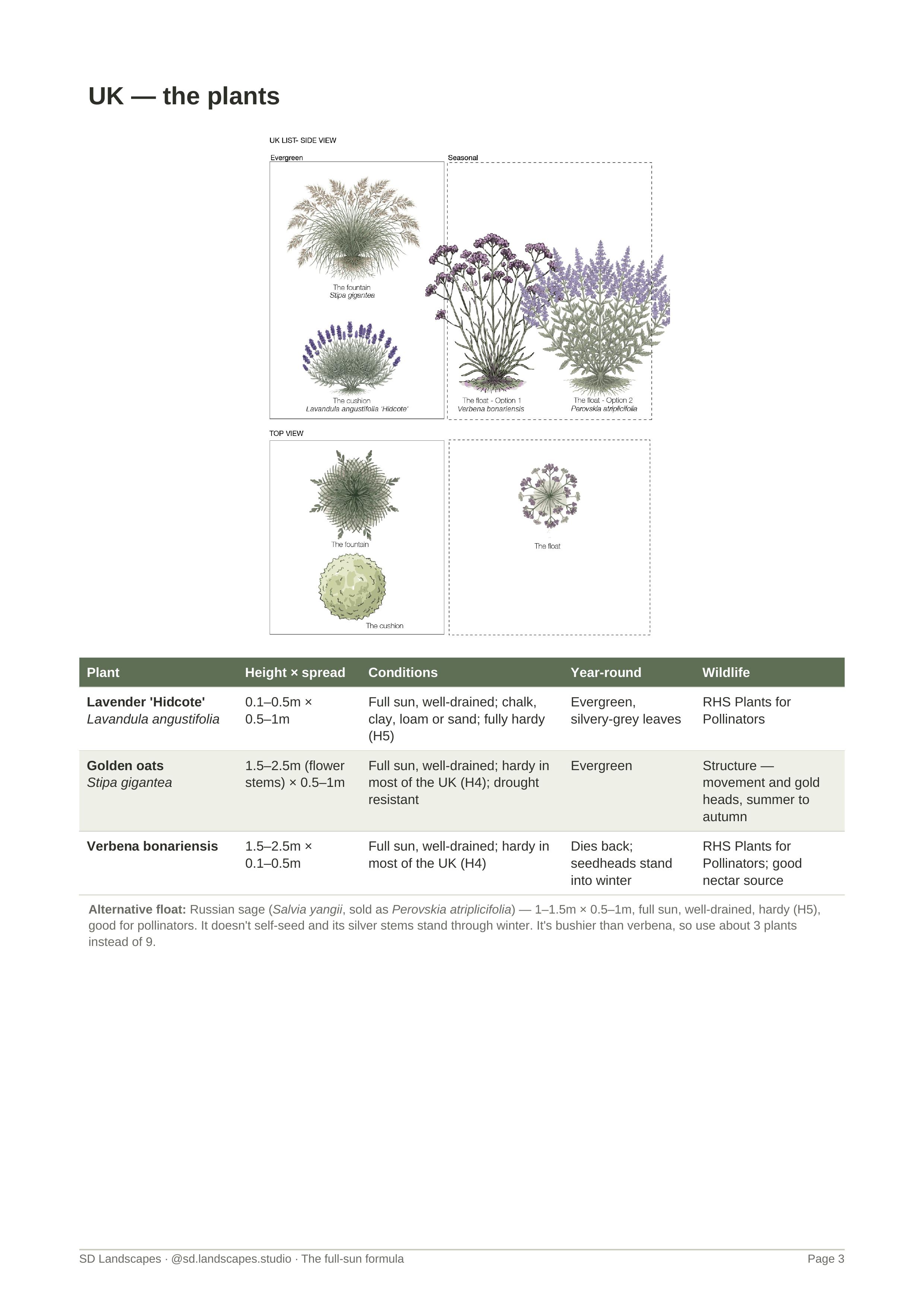
- Lavender 'Hidcote' Height 0.1–0.5m × spread 0.5–1m. Full sun, well-drained; chalk, clay, loam or sand; fully hardy (H5). Evergreen silvery-grey leaves year-round. RHS Plants for Pollinators.
- Golden oats (Stipa gigantea) Height 1.5–2.5m (flower stems) × spread 0.5–1m. Full sun, well-drained; hardy in most of the UK (H4); drought resistant. Evergreen. Provides structure, movement, and gold heads from summer to autumn.
- Verbena bonariensis Height 1.5–2.5m × spread 0.1–0.5m. Full sun, well-drained; hardy in most of the UK (H4). Dies back in winter but seedheads stand into winter. RHS Plants for Pollinators; good nectar source.
Alternative float: Russian sage
Russian sage (Salvia yangii, sold as Perovskia atriplicifolia) makes a good alternative to verbena. Height 1–1.5m × spread 0.5–1m, full sun, well-drained, hardy (H5), good for pollinators. It doesn't self-seed and its silver stems stand through winter. It's bushier than verbena, so use about 3 plants instead of 9.
Planting and care
Leave the gaps
Plant at final spacing, not shoulder to shoulder, and let the plants fill in over the next couple of seasons. Between them, add a thin, even layer of mulch. It isn't there to smother weeds or lock in moisture—it's purely a design decision. A light layer gives the ground one colour and texture, so the gaps read as negative space and each group stands out clearly. Keep it thin, and pull it back slightly from the lavender stems.
Through the year
- Lavender — late summer, just after flowering Remove the spent flower stalks and about 2.5cm of leafy growth. Don't cut into old, woody stems—lavender doesn't regrow well from old wood. In spring you can lightly clip over untidy or frost-damaged foliage.
- Golden oats — early to mid spring It's evergreen, so don't cut it to the ground. Comb out dead leaves and old flower stems by hand.
- Verbena — autumn and spring It can self-seed prolifically: deadhead in autumn if you don't want seedlings, or leave the seedheads for winter structure. Cut down in spring as new growth appears. In cold areas, protect the crown with a dry mulch over winter.
Planting tips
- Plant the cushion and fountain first; they're the year-round structure.
- Water new plants in well and keep them watered through their first summer while they establish.
- Odd-looking gaps in year one are normal. By year two or three the bed will read as one planting.
Australia — same formula, native plants
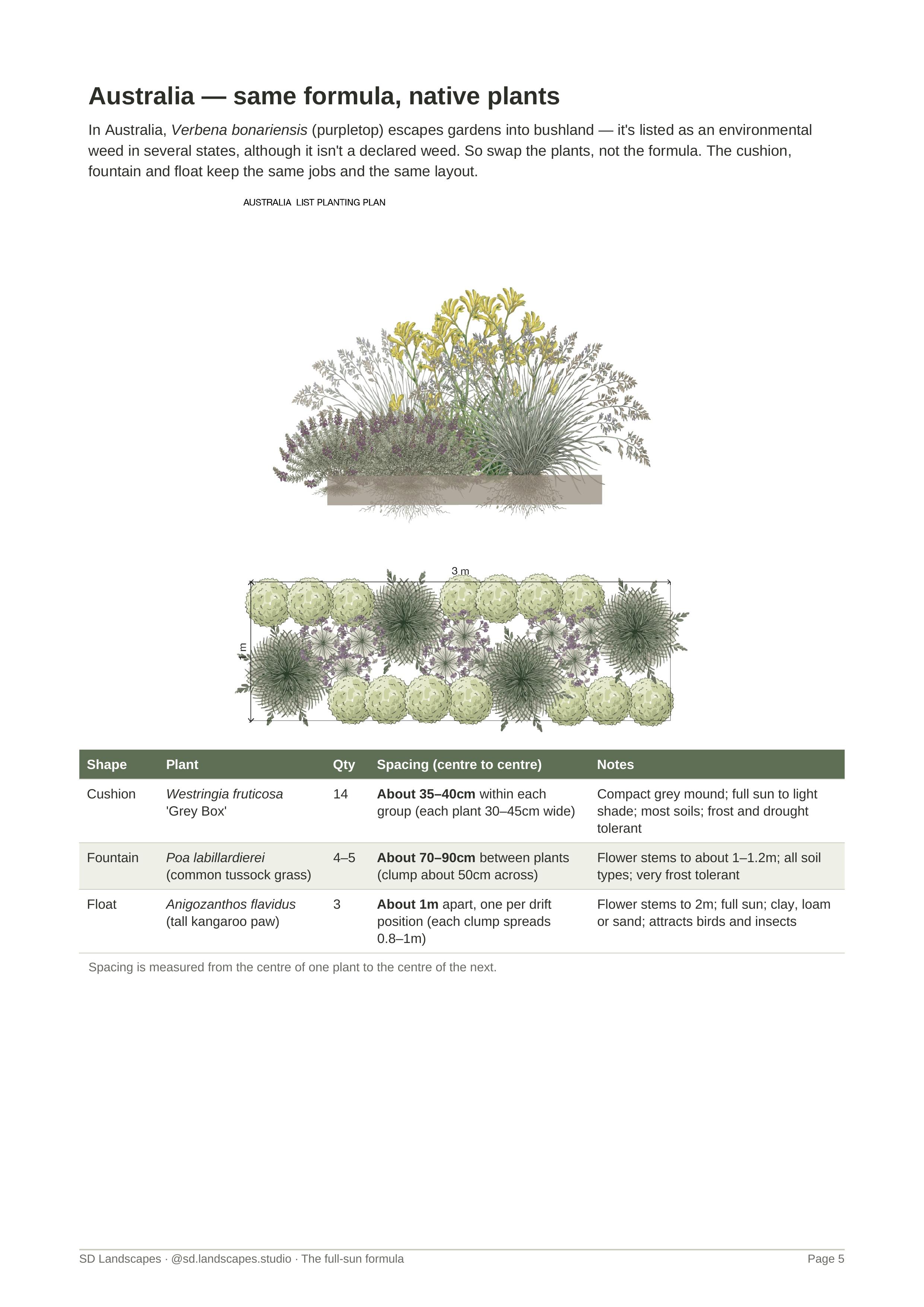
In Australia, Verbena bonariensis (purpletop) escapes gardens into bushland—it's listed as an environmental weed in several states, although it isn't a declared weed. So swap the plants, not the formula. The cushion, fountain, and float keep the same jobs and the same layout.
Australian plant list
- Cushion: Westringia fruticosa 'Grey Box' Qty 14. Space about 35–40cm within each group (each plant 30–45cm wide). Compact grey mound; full sun to light shade; most soils; frost and drought tolerant.
- Fountain: Poa labillardierei (common tussock grass) Qty 4–5. Space about 70–90cm between plants (clump about 50cm across). Flower stems to about 1–1.2m; all soil types; very frost tolerant.
- Float: Anigozanthos flavidus (tall kangaroo paw) Qty 3. Space about 1m apart, one per drift position (each clump spreads 0.8–1m). Flower stems to 2m; full sun; clay, loam or sand; attracts birds and insects.
Australian notes
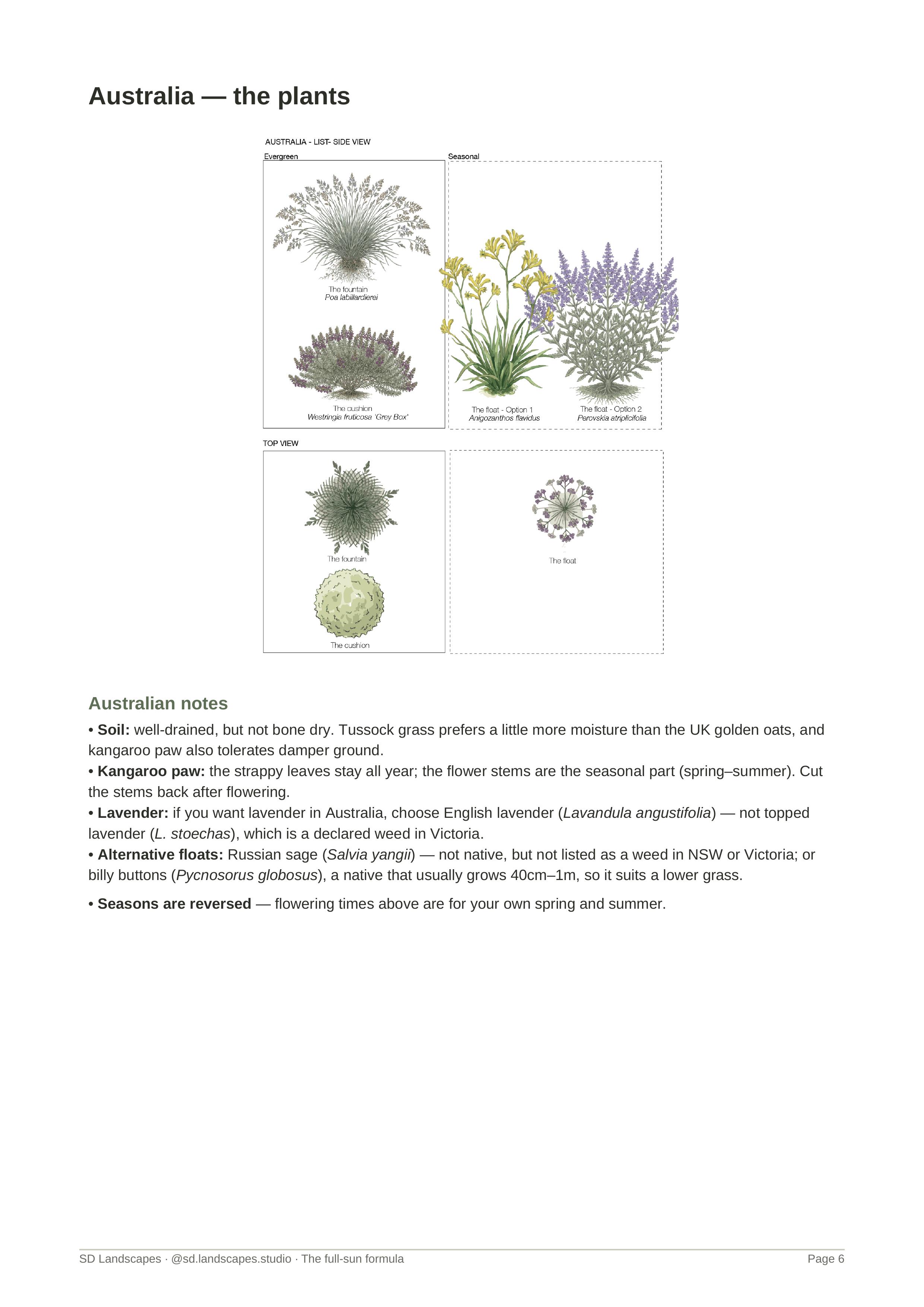
- Soil Well-drained, but not bone dry. Tussock grass prefers a little more moisture than the UK golden oats, and kangaroo paw also tolerates damper ground.
- Kangaroo paw The strappy leaves stay all year; the flower stems are the seasonal part (spring–summer). Cut the stems back after flowering.
- Lavender in Australia If you want lavender in Australia, choose English lavender (Lavandula angustifolia)—not topped lavender (L. stoechas), which is a declared weed in Victoria.
- Alternative floats Russian sage (Salvia yangii)—not native, but not listed as a weed in NSW or Victoria. Or billy buttons (Pycnosorus globosus), a native that usually grows 40cm–1m, so it suits a lower grass.
- Seasons reversed Flowering times above are for your own spring and summer.
Sources and before you plant
Plant sizes, conditions, and care are taken from reliable horticultural and government sources. UK: Royal Horticultural Society (RHS) plant profiles and growing guides. Australia: Botanic Gardens of South Australia, Australian National Botanic Gardens, Australian Plants Society, VicFlora, and Ozbreed cultivar specifications.
Before you plant
Plants in this guide are selected for UK conditions, with a separate Australian list. Before planting outside the UK, check your state or national invasive plant list—a plant that's fine in one country can be a weed in another. Planting plans and quantities are indicative only. Check your own site's light, soil, and drainage before buying, and adjust quantities to the size of your bed.
Planting advice here is written for UK conditions. Some of these plants are invasive or weedy in other countries, so check your local invasive plant list before planting.