
The Zigzag Drought Border
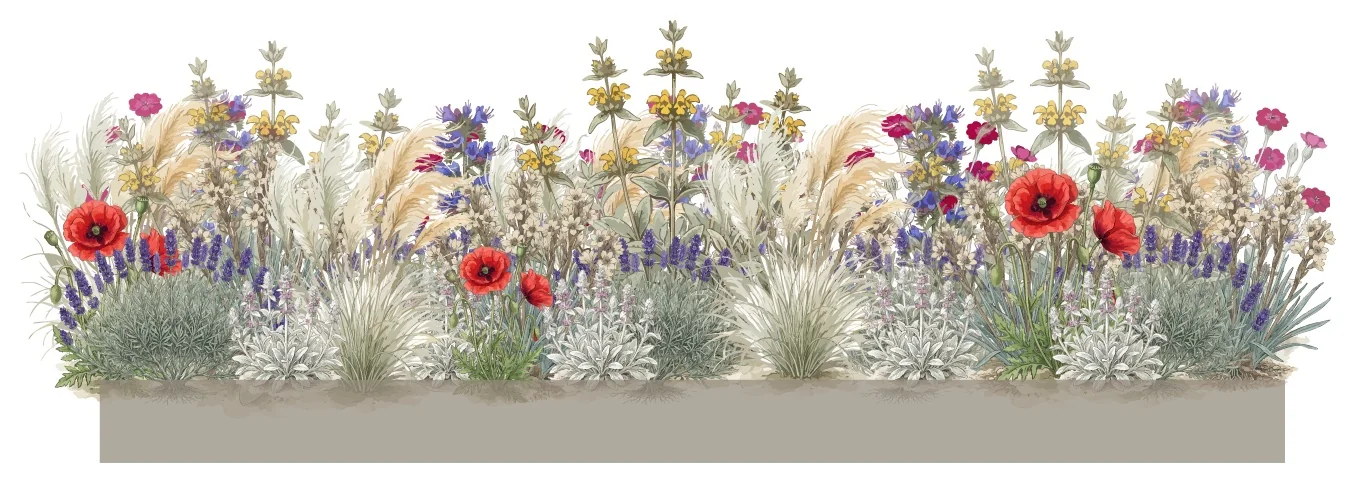
Drought plants dotted around on their own can make a bed look a bit empty. Lay them out in three zigzag layers instead — plant list from SD Landscapes (@sd.landscapes.studio).
The bed
1.5 × 3m, in full sun, with free-draining soil.
The formula
- 1. Evergreen frame Gives the bed shape all year. 3 Phlomis staggered back, forward, back, with a lavender zigzag along the front.
- 2. Semi-evergreen Fills in through the gaps. Stachys, Sisyrinchium, Stipa and Lychnis, zigzagging through the gaps.
- 3. Deciduous + self-seeders Drifts and fills gaps. Wild marjoram, field scabious, knapweed, viper's bugloss and field poppy. They won't stay in the zigzag: they drift and fill gaps, which makes it look natural.
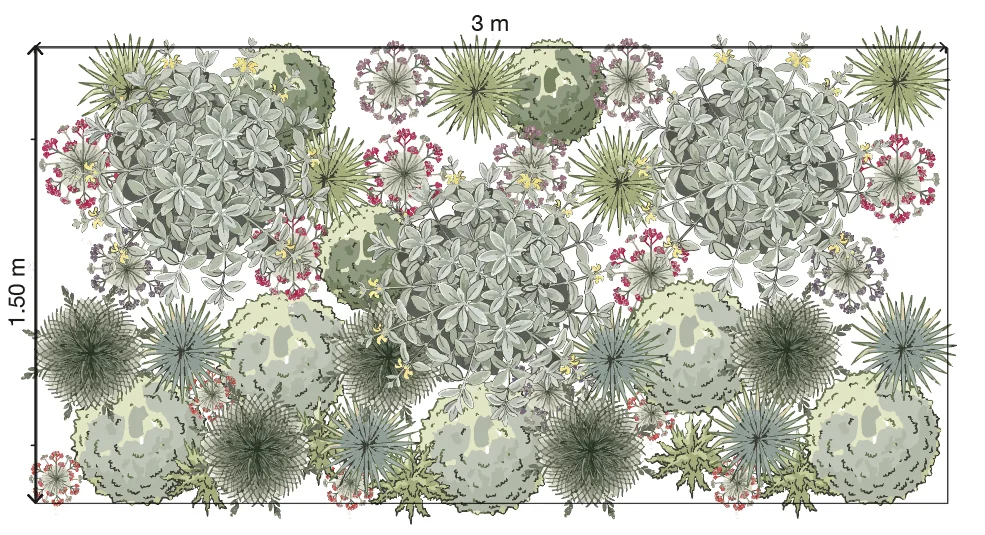
The planting plan
Top view · 3m × 1.5m.
The rules
- Tall at the back Low mounds at the front, with grasses floating through.
- Odd numbers, repeated Plant in 3s and 5s, and repeat them along the bed.
- Zigzag, never rows Every layer steps back and forward, never in a straight line.
- Self-seeders last Add them at the end, in the gaps.
The plants
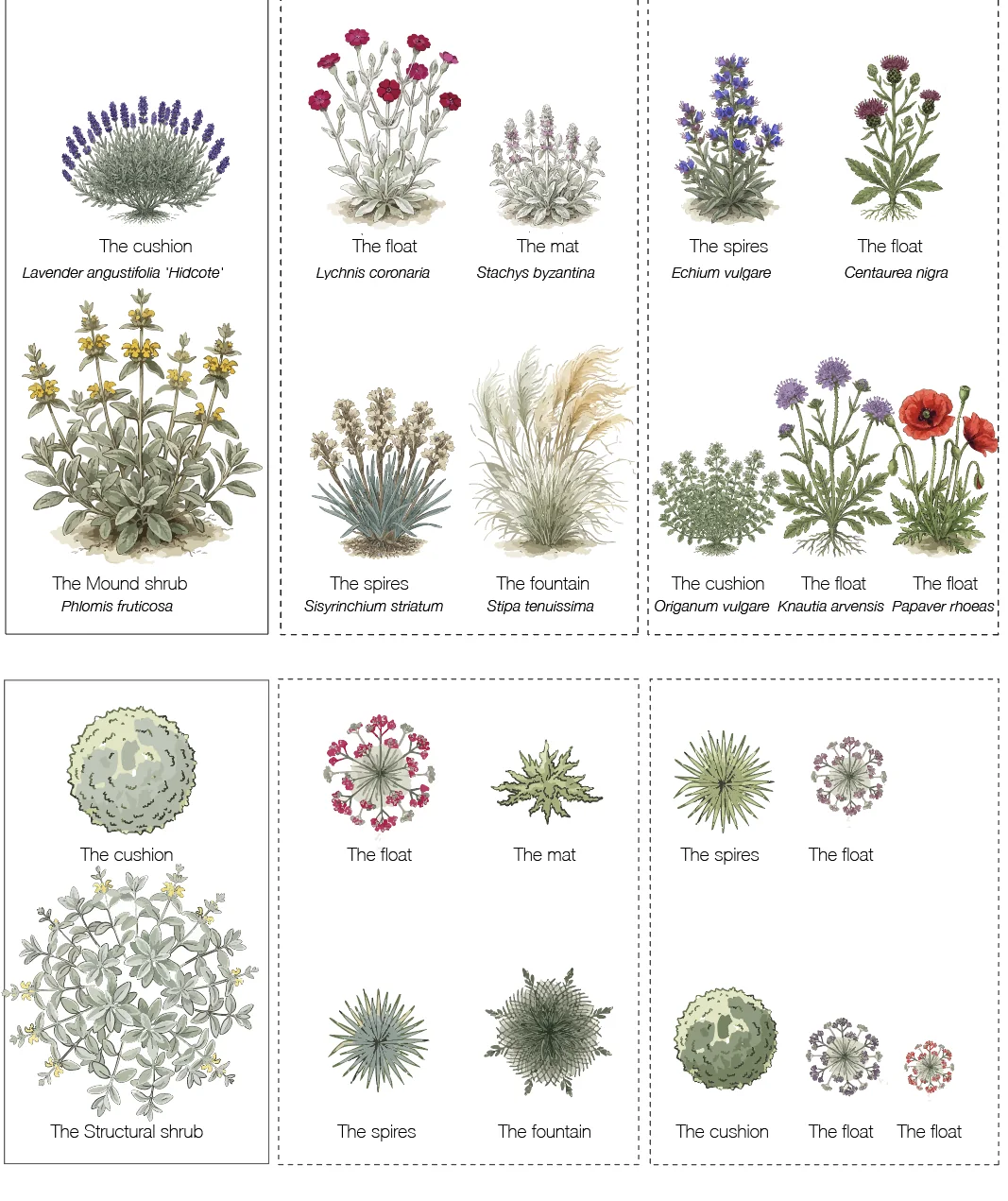
Each plant drawn from the side (top) and from above (bottom), grouped by layer.
Plant list
- Evergreen: Phlomis fruticosa Structural shrub/mound. Evergreen? Yes. Height × spread 1m × 1.2m. Planting gap 90–100cm. Native? No. Wildlife value: High: bumblebees.
- Evergreen: Lavandula angustifolia 'Hidcote' Cushion. Evergreen? Yes. Height × spread 50 × 60cm. Planting gap 40–45cm. Native? No. Wildlife value: Very high: bees, butterflies.
- Semi-evergreen: Stachys byzantina Mat. Evergreen? Semi. Height × spread 40 × 60cm. Planting gap 40–45cm. Native? No. Wildlife value: High: wool carder bees.
- Semi-evergreen: Sisyrinchium striatum Spires. Evergreen? Mostly. Height × spread 60 × 30cm. Planting gap 30cm. Native? No. Wildlife value: Low–medium.
- Semi-evergreen: Stipa tenuissima Fountain (self-seeds). Evergreen? Semi. Height × spread 60 × 40cm. Planting gap 35–40cm. Native? No. Wildlife value: Low.
- Semi-evergreen: Lychnis coronaria Float (self-seeds). Evergreen? Semi. Height × spread 70 × 40cm. Planting gap 40cm. Native? No. Wildlife value: Medium.
- Deciduous: Origanum vulgare (wild marjoram) Cushion. Evergreen? No. Height × spread 50 × 50cm. Planting gap 40cm. Native? Yes. Wildlife value: Very high: butterflies, bees.
- Deciduous: Knautia arvensis (field scabious) Float. Evergreen? No (rosette). Height × spread 80 × 40cm. Planting gap 40cm. Native? Yes. Wildlife value: Very high.
- Deciduous: Centaurea nigra (common knapweed) Float. Evergreen? No. Height × spread 70 × 45cm. Planting gap 40cm. Native? Yes. Wildlife value: Very high.
- Deciduous: Echium vulgare (viper's bugloss) Spires (self-seeds). Evergreen? No (rosette). Height × spread 80 × 30cm. Planting gap 35–40cm. Native? Yes. Wildlife value: Very high: bees.
- Deciduous: Papaver rhoeas (field poppy) Float (sow once, self-seeds). Evergreen? Annual. Height × spread 60 × 15cm. Planting gap: Sow thinly. Native? Archaeophyte. Wildlife value: High: pollen.
Notes
- Native wildflowers first with a few tough Mediterranean plants for a drier climate.
- Water everything regularly in the first year until the roots establish.
- Stipa can self-seed heavily. Pull out the extras in spring. (In Australia, consider a local native grass instead.)
Before you plant
Plants in this guide are selected for UK conditions. Outside the UK? Check plants against your local invasive species list before planting — a plant that's fine in one country can be a weed in another. Planting plans and quantities are indicative only. Check your own site's light, soil and drainage before buying, and adjust quantities to the size of your bed.
Planting advice here is written for UK conditions. Some of these plants are invasive or weedy in other countries, so check your local invasive plant list before planting.