
5 Plants for Dry Shade Under a Deciduous Tree
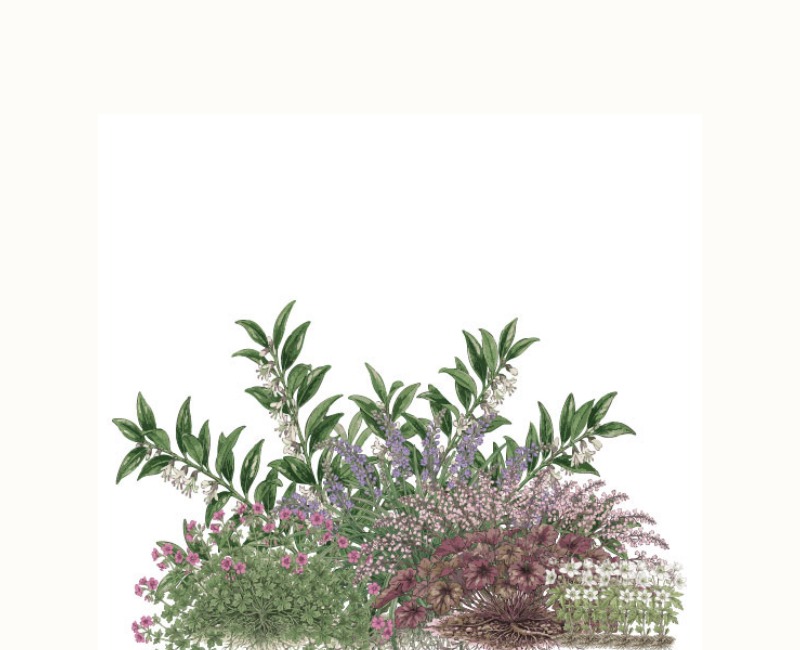
Dry shade under a deciduous tree is one of the trickiest spots in any garden—tree roots steal moisture, the canopy blocks rain, and summer shade is dense. But it's also one of the most rewarding to plant well. This guide uses the five-shape formula to fill every layer of a small bed (~2m²) with plants that genuinely share these conditions, not just look good together in a mood board. Plant list adapted from SD Landscapes (@sd.landscapes.studio).
Why the five-shape formula works here
Every planting-under-trees bed in this series uses the same five shapes—not five specific plants, but five roles a bed needs filled. Under a deciduous tree, all five roles can be filled because the bare winter canopy and lighter spring light give one extra plant room to work that a conifer bed can't offer.
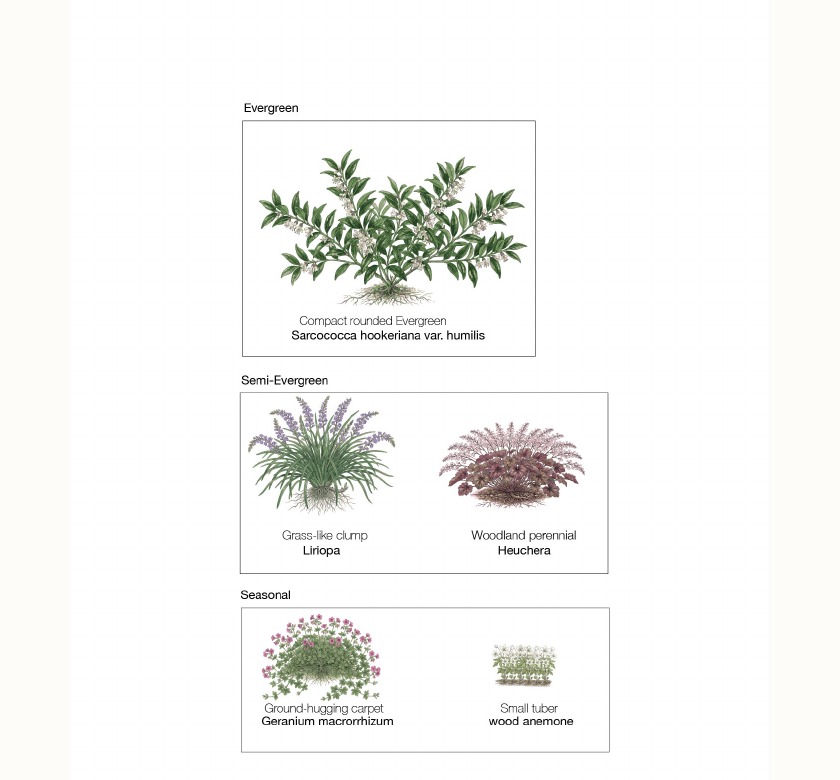
- Compact rounded evergreen The anchor, in leaf all year. Provides structure when everything else dies back.
- Ground-hugging carpet Spreads to knit the bed together. Covers bare soil and suppresses weeds.
- Woodland perennial Texture and colour at knee height. The colour layer that lifts the scheme.
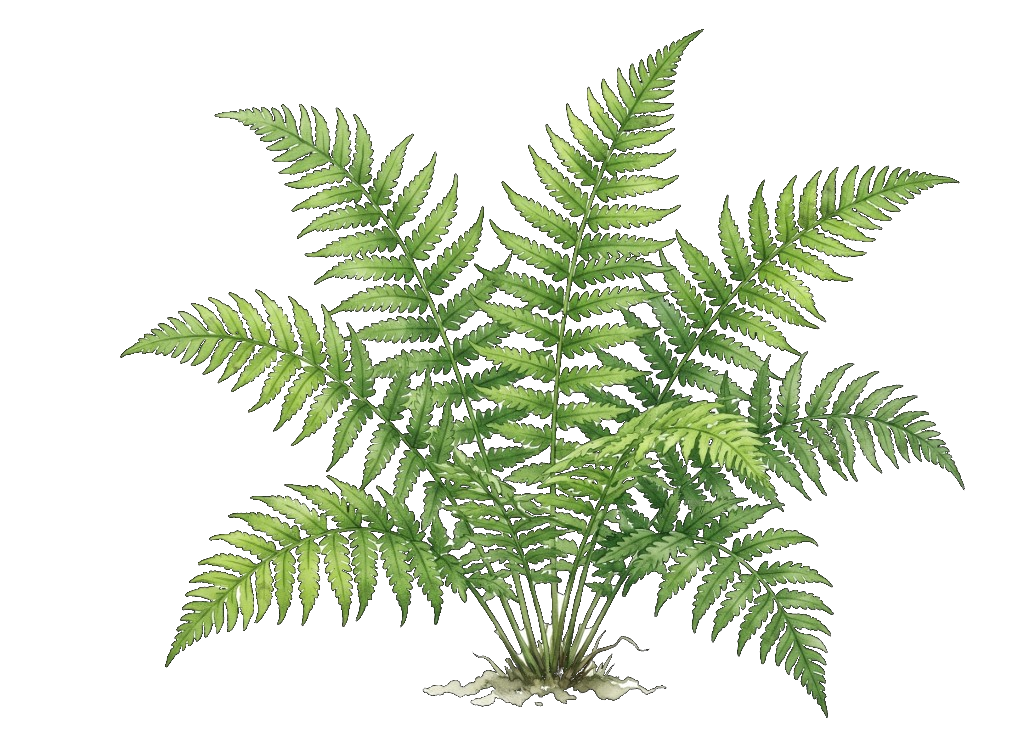
- Fern or grass-like clump The upright, structural note. Adds vertical contrast to mounding shapes.
- Small bulb or tuber The deciduous-only bonus—flowering before the canopy closes over, then dormant by summer.
Check your conditions first
This planting plan is specifically for dry shade under a deciduous tree. Confirm your spot matches before planting:
- Deciduous canopy The tree loses its leaves in winter, letting light and rain through from autumn to spring. This is what allows the full five-shape formula to work.
- Dry shade The soil is drier than you'd expect for a shaded spot. Tree roots compete for moisture, and the canopy intercepts rain. Even after rain, the soil under a mature tree can stay surprisingly dry.
- Root competition Expect the soil squeeze test to read drier than it actually feels because tree roots will outcompete your plants for any moisture that does reach the soil.
Conifer dry shade is different
Year-round needle cover means no spring light window and typically more acidic soil. Under conifers, you can only fill two of the five shapes. This guide is for deciduous trees only.
The five plants
1. Sarcococca hookeriana var. humilis — compact rounded evergreen
- Quantity 1 plant as the anchor, set back from the trunk where soil is slightly less root-bound.
- Mature size 45–60cm tall, spreading by suckers over time. Occasional trim keeps it compact.
- Why it works RHS-confirmed for dry shade once established. Powerfully fragrant white flowers in winter when little else is happening. Evergreen glossy leaves year-round.
- Source Garden centre. Also known as Himalayan sweet box.
2. Geranium macrorrhizum — ground-hugging carpet
- Quantity 5–7 plants for approximately 2m², spaced ~40cm apart.
- Mature size ~45cm high with 0.5–1m spread. Semi-evergreen and mat-forming.
- Why it works Genuinely tolerates dry shade. The loose, open habit lets wood anemone flower through it in spring. Aromatic foliage and pink or white flowers.
- Fallback option In the driest, darkest patches where even bigroot geranium struggles, use Hedera helix (common ivy) instead—less interesting but nearly indestructible.
- Source Garden centre. Also known as bigroot geranium.
3. Heuchera — woodland perennial
- Quantity 4–6 plants, spaced ~30cm apart.
- Cultivar choice 'Palace Purple' or another dry-shade-tolerant cultivar. Foliage colours range from near-black to lime green.
- Why it works This is the colour layer—the foliage lifts the scheme and provides texture at knee height. Semi-evergreen in mild winters.
- Source Garden centre. Many cultivars available; choose by foliage colour preference.
4. Liriope muscari — grass-like clump
- Quantity 3–4 plants, spaced ~30–40cm apart.
- Mature size 30–45cm tall, clump-forming. Evergreen strappy foliage.
- Why it works Drought-tolerant and handles deep shade well for foliage. Adds vertical, grass-like texture that contrasts with the mounding shapes around it.
- Flowering caveat Needs some direct sun to flower well. In deep shade, treat it as reliable foliage first—the purple flower spikes are a bonus, not a guarantee.
- Source Garden centre. Also known as lilyturf.
5. Anemone nemorosa — small bulb or tuber
- Quantity 10–15 rhizomes for approximately 2m², spaced ~15cm apart in naturalistic drifts.
- Timing Flowers before the canopy closes in early spring, then goes completely dormant by early summer. You won't see it at all from June onwards.
- Planting approach Underplant through the geranium carpet—the geranium's loose habit lets the anemone flower through, then covers the gap when it dies back.
- Source Specialist nursery for autumn rhizomes (best establishment); garden centre for spring pots (more expensive, less reliable).
Planting tips for dry shade
- Water well at planting and through the first summer while roots establish. Once settled, these plants cope with dry conditions—but they need help getting started.
- Plant in autumn if possible. Cooler, wetter months help roots establish before the tree leafs out and competition for water intensifies.
- Add organic matter to planting holes to improve moisture retention, but don't create a sump that water pools in.
- Mulch with leaf mould or bark to retain moisture and mimic the natural woodland floor these plants evolved in.
- Accept that growth will be slower than in open ground. Tree root competition is real—these plants will establish, but they won't romp.
Source note
This plant list is adapted from SD Landscapes (@sd.landscapes.studio), specialists in small-space and challenging-condition planting design. Fact-checked against RHS plant data.
Planting advice here is written for UK conditions. Some of these plants are invasive or weedy in other countries, so check your local invasive plant list before planting.