
Sunny Balcony Planting for Wind-Exposed High-Rise Spaces
A fully exposed balcony on a mid-to-high-rise building presents a unique challenge: no wall, wind funnelling through, and the rail taking the brunt of the gusts. The solution? Let the planting itself do the sheltering. Two heavy anchor pots with tough evergreens act as living windbreaks, and everything softer tucks into their lee. This guide covers a practical plant list for a wind-tunnel balcony, with the layout logic that makes it work. Plant list adapted from SD Landscapes (@sd.landscapes.studio).
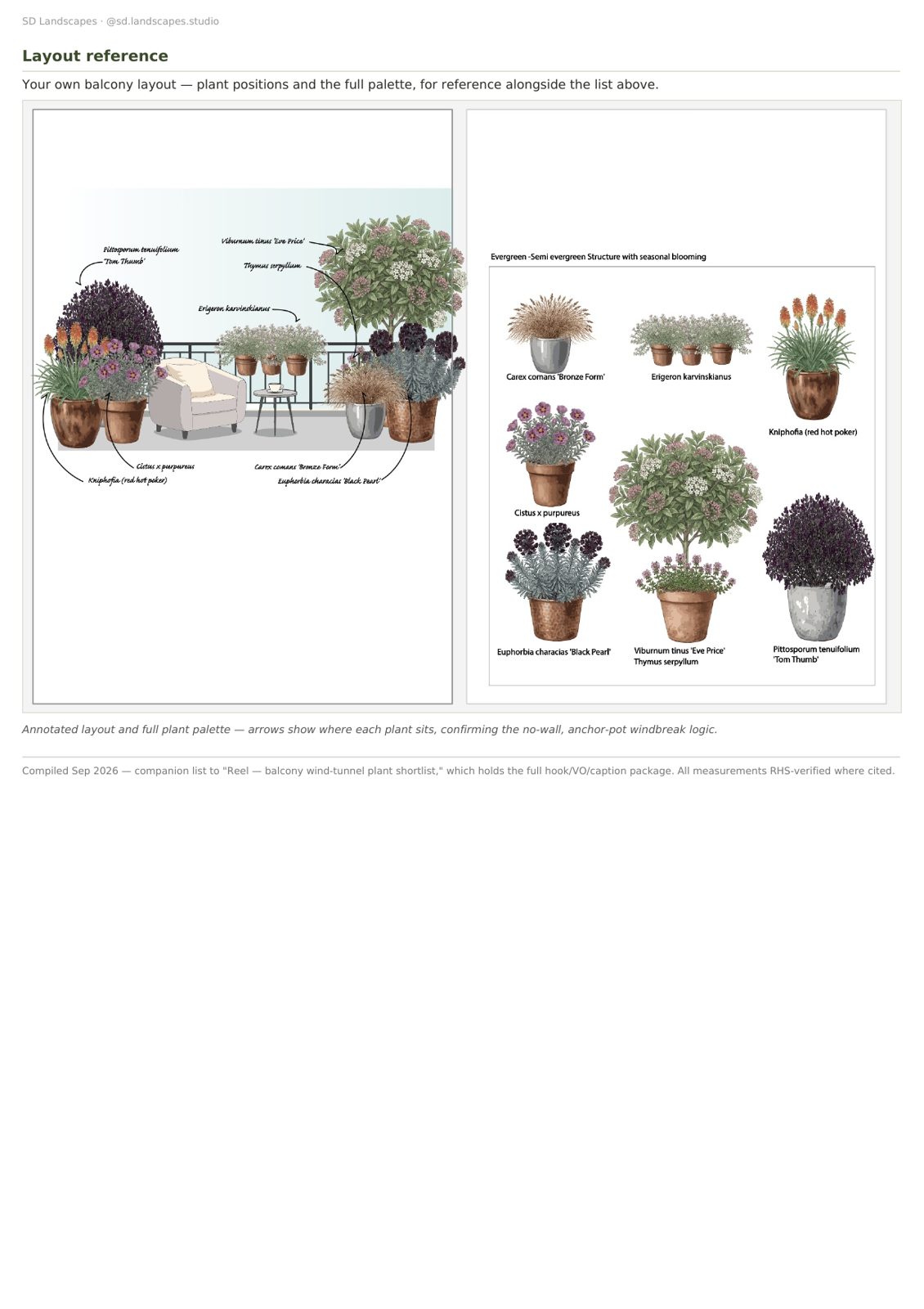
The windbreak logic
In a normal garden, a wall or fence breaks the wind. On a balcony with no wall—just railings open to the city—the planting itself has to do that job. The approach:
- Two architectural anchors Heavy pots at each end of the balcony, planted with tough evergreens trained to height. These intercept the wind before it reaches the seating area.
- Sheltered lee zone Everything else sits between or behind the anchors, protected from direct gusts. This is where your softer, showier plants go.
- Rail gap exception The only truly exposed spot is the rail gap between the two anchors. Here, choose the single toughest, lowest-growing plant that can handle full wind and still look good.
Give anchors time
Let the two anchor pots establish for a season before relying on them as shelter. New plants are most vulnerable to wind-rock before their roots grip the compost.
Anchor windbreak plants
Position these at opposite ends of the balcony in heavy, stable pots. They form the structural backbone of the planting and need to be wind-tolerant evergreens.
- Pittosporum tenuifolium 'Tom Thumb' (left anchor) Qty 1. Compact, dense evergreen with deep purple-bronze leaves. Mature pot size 0.5–0.8m × 0.5–0.7m. Wind-tolerant; barely changes size in a pot. Source: garden centre.
- Viburnum tinus 'Eve Price' — trained as standard (right anchor) Qty 1. Trained as a lollipop standard to give height without bulk at ground level. Mature pot size 1–1.2m × 0.8–1m. Needs annual pruning to hold shape. Winter-spring flowers. Source: garden centre.
Sheltered plants for the lee zone
These plants tuck between or behind the anchors, protected from the worst of the wind. Choose pots that complement your anchor pots in style but can be smaller and lighter.
- Kniphofia — red hot poker (compact cultivar) Qty 1. Choose a compact cultivar such as 'Nancy's Red' or 'Poco Red' (not the tall border types). Pot size approximately 0.5–0.7m × 0.8m. Semi-evergreen; dramatic flower spikes in summer. May need replacing after 5–8 years. Source: garden centre.
- Cistus × purpureus — rock rose Qty 1. Mediterranean tough with papery pink flowers and dark blotches. Evergreen. Pot size approximately 0.5–0.8m × 0.8m. Genuinely Mediterranean-tough and copes with full sun. Source: garden centre.
- Carex comans 'Bronze Form' — bronze sedge Qty 1. Fine, arching bronze-green foliage. Evergreen grass-like plant that copes with full sun and flexes in wind rather than resisting it. Naturally compact, clump-forming. Source: garden centre.
- Euphorbia characias 'Black Pearl' Qty 1. Drought and wind tolerant with striking lime-green flower heads in spring. Compact cultivar that works well in pots as-is. Source: garden centre.
- Thymus serpyllum — wild thyme (at Viburnum base) Qty 1. Low mat of aromatic evergreen foliage with summer flowers. Plant at the base of the Viburnum pot or in a naturally pot-suited low container. RHS H5 rated for exposed or sheltered sites. Source: garden centre.
Exposed rail gap: the tough one
The rail gap between the two anchors stays exposed. This needs a genuinely wind-tolerant plant that stays low and self-seeds into cracks—a survivor, not a statement piece.
- Erigeron karvinskianus — Mexican fleabane Qty 3. Plant in a trough or several small pots spanning 15–30cm × 30–50cm total. Semi-evergreen daisy that self-seeds cheerfully into gaps. RHS H5, genuinely wind-tolerant, and tough enough to handle the exposed position. Source: garden centre.
Practical balcony considerations
- Weight limits Heavy pots are the point—they anchor against wind. But check what your balcony can actually bear, especially on an upper floor. Wet compost adds significant weight.
- Wind-rock on new plants New plants are most vulnerable before roots establish. A slightly bigger starting pot, or light staking for the first season, reduces losses.
- Watering regime Wind dries pots faster than you'd expect. Check moisture regularly, especially for the exposed rail-gap plants.
- Establishment time Give the two anchor pots a full season to root properly before you rely on them to shelter the rest. Plant the sheltered-zone species once the anchors are stable.
Source note
This plant list is adapted from SD Landscapes (@sd.landscapes.studio), specialists in balcony and small-space planting design. All measurements are RHS-verified where cited.