Planting guide · Full sun · Dry soil
The five-shape formula, remixed for drought
Five evergreen shapes for full sun and free-draining soil, plus an upright accent and a few bulbs.
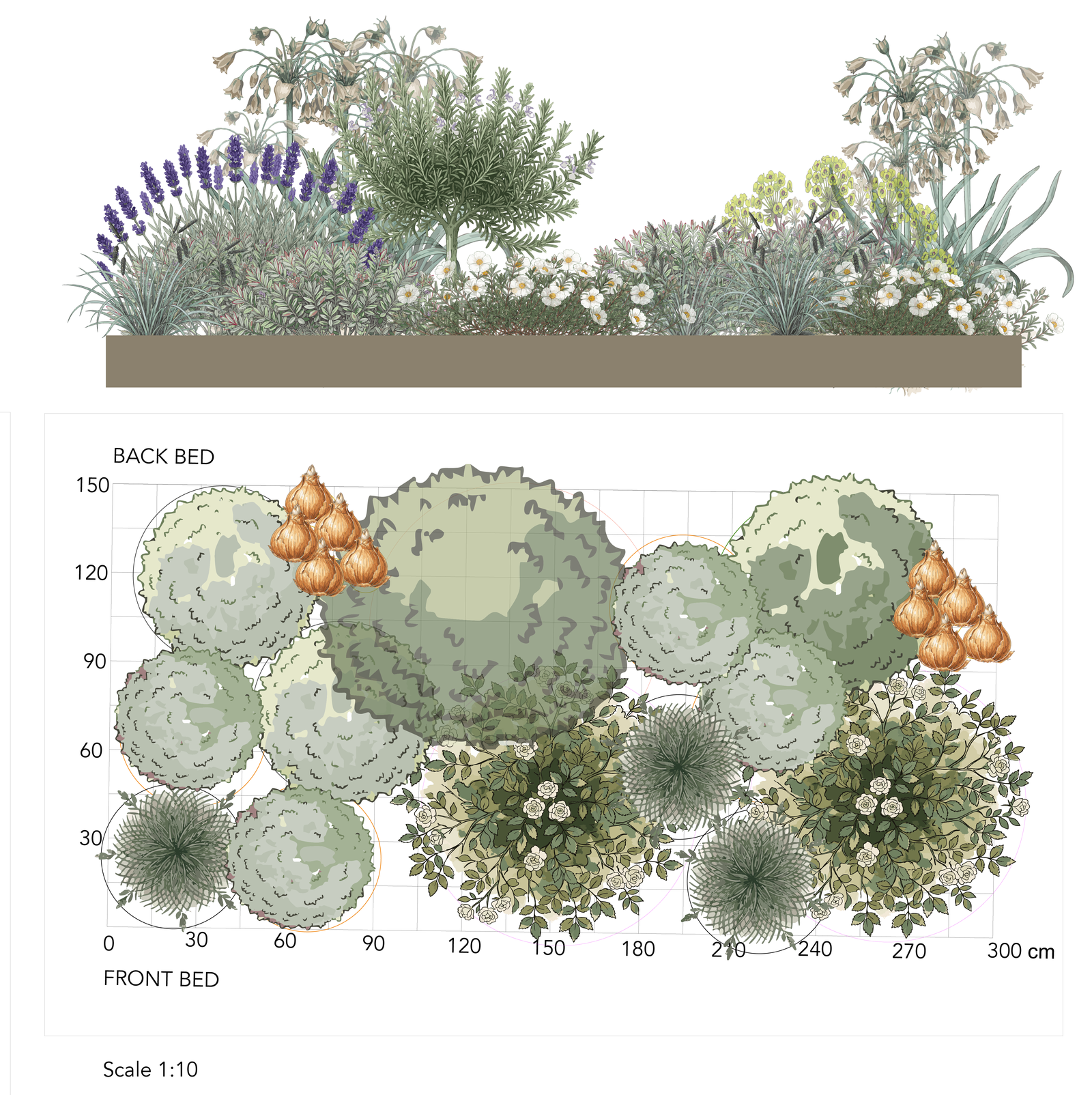
Front view and plan, 300 × 150 cm, scale 1:10.
- 300 × 150 cm
- Bed size
- 7 plant types
- All drought rated
- 6+ hours sun
- At midsummer
- UK gardens
- Written for
PDF, with a free Garden Pal account
The plan and front-view symbols used in this guide, exclusive to Garden Pal.
The bed
The same five shapes: a tall round focal, a grass-like plant, a mound, a groundcover and a short round, plus an upright accent and a few bulbs.
The bed is 300 × 150 cm, in full sun, on free-draining chalk, loam or sand, neutral to alkaline. Full sun means more than 6 hours of direct sun at midsummer. Every structure plant is evergreen and rated drought resistant by the RHS. The honey garlic bulbs are drought rated too. Written for UK gardens. These plants are chosen because they suit those conditions.
The formula
It follows the five shapes of the full-sun dry bed, with a drought-rated plant in each shape. An upright spurge sits with the grass-like layer, and honey garlic bulbs add summer colour.
Plants in this guide
7 plant types
- View plant, Rosemary 'Gorizia'
Tall round focal · Qty 1
Rosemary 'Gorizia'Salvia rosmarinus 'Gorizia'
Grown as a clipped standard, at the size drawn on this plan, not an RHS measurement. Aromatic evergreen leaves and pale violet-blue flowers in spring, often again in autumn.
- View plant, Glaucous sedge
Grass-like · Qty 3
Glaucous sedgeCarex flacca
Three plants are planned at 50 cm across so they fit the bed; divide or trim a clump that spreads wider. Stiff evergreen leaves, green above and glaucous blue beneath, with purple-brown flower spikes in early summer.
- View plant, Martin's spurge
Upright accent · Qty 1
Martin's spurgeEuphorbia × martini
Narrow dark grey-green leaves and open sprays of greenish-yellow flowers, sometimes purple-eyed, in spring and summer.
- View plant, English lavender 'Hidcote'
Mound · Qty 2
English lavender 'Hidcote'Lavandula angustifolia 'Hidcote'
On this plan each plant is kept to about 60 cm across. Narrow silvery-grey leaves and deep violet-purple flowers in dense, aromatic spikes in summer.
Groundcover · Qty 2
Sahuc rock roseCistus × sahucii
This plan keeps each plant to about 80 cm, and the front one low enough that the rosemary stem stays visible. Narrow dark green leaves and pure white flowers with yellow stamens in summer.
- View plant, Hebe 'Red Edge'
Short round · Qty 4
Hebe 'Red Edge'Veronica 'Red Edge'
A compact evergreen shrub with blue-grey leaves edged red, especially in winter, and pale mauve flowers fading to white in summer. The red edge sits against the silver and blue of the other shrubs.
- View plant, Sicilian honey garlic
Seasonal layer · Qty About 10
Sicilian honey garlicAllium siculum
About 10 bulbs, in two groups of five, the seasonal layer among the evergreen structure plants. Nodding cream, pink and green bells in summer, then upright seed pods in late summer, on fragrant foliage.
Height and spread are the size used on this 300 × 150 cm plan. Every structure plant is evergreen and rated drought resistant by the RHS. The honey garlic is the seasonal bulb layer.
Colour and wildlife
The spurge's greenish-yellow heads and the honey garlic's cream, pink and green bells break up the grey, silver and blue of the rosemary, lavender, sedge and rock rose.
RHS Plants for Pollinators: rosemary 'Gorizia', lavender 'Hidcote', hebe 'Red Edge', Martin's spurge and Sicilian honey garlic. Glaucous sedge and Sahuc rock rose have no RHS Plants for Pollinators tag.
The planting plan
Front view and plan, 300 × 150 cm, scale 1:10. Made with digital and AI tools, then corrected and sized by a landscape architect.
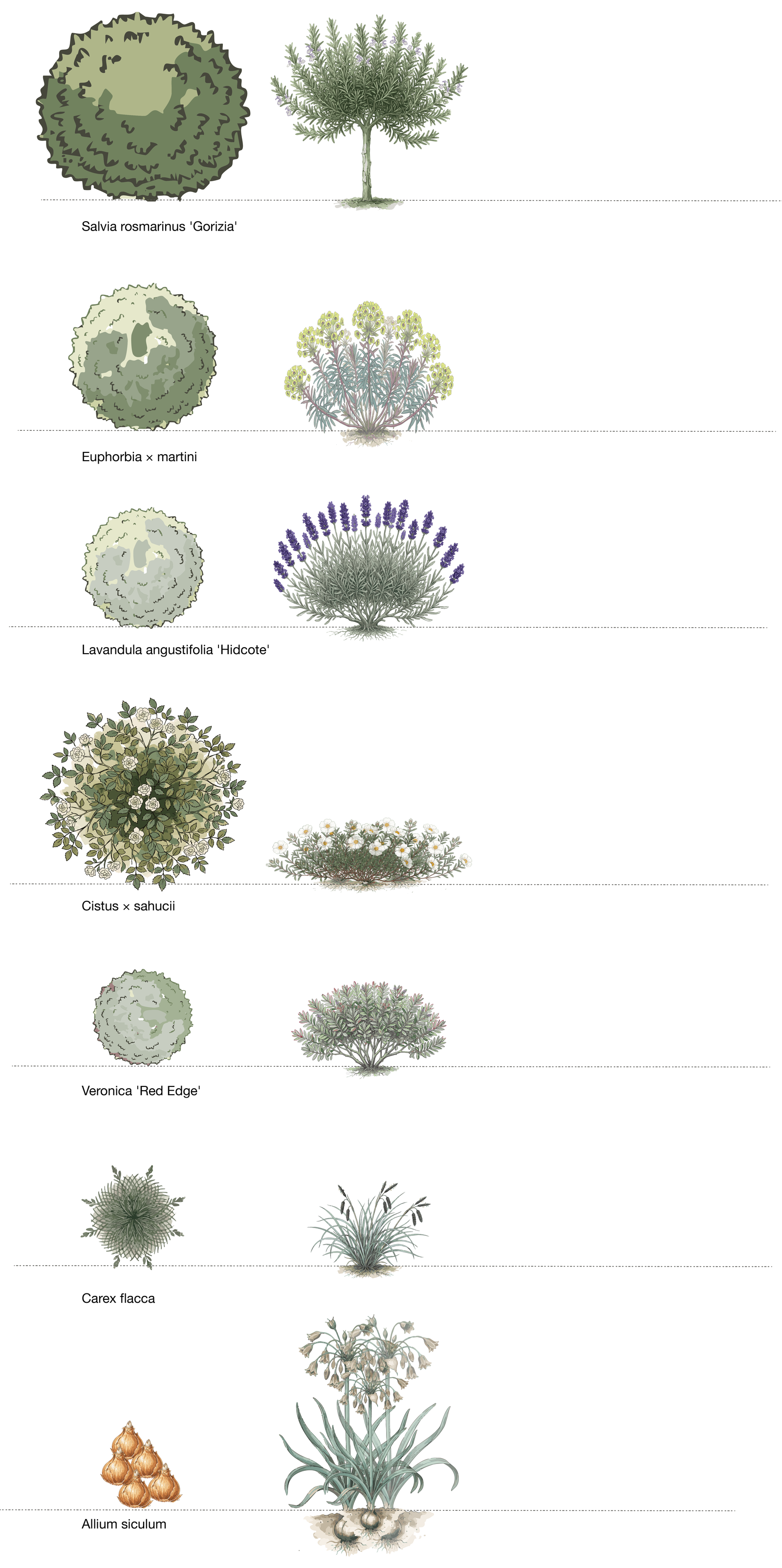
Plan symbol and front view for each plant. Made with digital and AI tools, then corrected and sized by a landscape architect.
Sources: RHS plant profiles and Garden Pal's plant records. Where a plant is kept smaller than its full size, that is the size used on this plan.
Illustration credit: Garden Pal
Spacing and care
Neighbouring plants may knit by up to about 8 cm at these sizes. They will touch, so trim them lightly to keep the shapes apart. The front rock rose and the sedges tuck under the edge of the rosemary head and stay at least 25 cm from the stem. The lavender, the hebes and the spurge stay outside the head. The bulbs come up through the edges of the lavender, the spurge and the right-hand rock rose.
- Trim the rock rose, the lavender and the hebe lightly after flowering. Keep each rock rose to about 80 cm across.
- Lavender: take only the spent flower stalks and a little of the current season's leaf. Do not cut into old wood.
- If the sedge spreads past the 50 cm used on this plan, divide it or trim it.
Good to know
When to plant
The RHS says November is an excellent time to plant shrubs and herbaceous plants. Roots can keep growing through winter, before the next dry summer.
Martin's spurge sap
Safety
The milky sap of Martin's spurge irritates skin and eyes, and it is harmful if eaten. Wear gloves when you cut spent stems.
Honey garlic bulbs
Safety
Allium bulbs are not to be eaten.
Sourcing 'Gorizia'
A 'Gorizia' standard is hard to source. Plain rosemary has no RHS drought rating, so this plan names 'Gorizia'.
On heavy clay?
A drought-tolerant clay version is coming next.
Next steps
Planting advice here is written for UK conditions. Some of these plants are invasive or weedy in other countries, so check your local invasive plant list before planting.