
SD Landscapes · @sd.landscapes.studio · Garden Pal planting guide
The Spring Wave Bed
An evergreen frame, with spring flowers arriving in waves
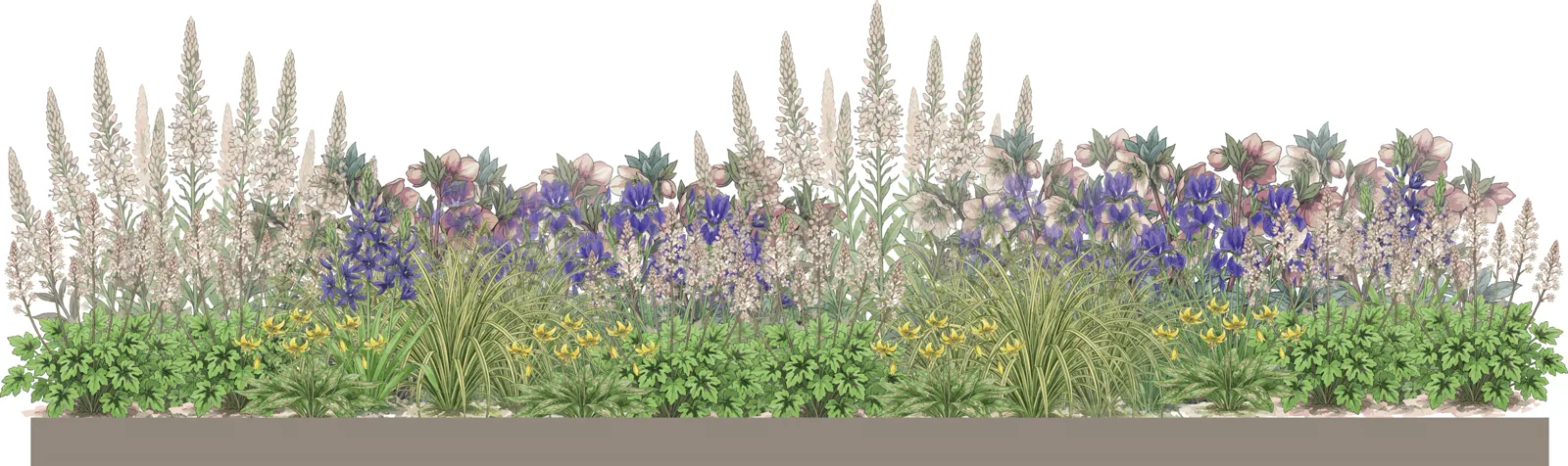
A bed that flowers all at once looks wonderful for two weeks and empty for the rest of the year. This one works the other way round. A frame of plants that keep their leaves gives the bed its shape all year. Then from late winter to early summer the flowers come through in waves: each one opens as the last one fades, and the green stays.
Download the free illustrated plan (PDF)
Create a free Garden Pal account to save the illustrated plan to your phone.
The planting plan
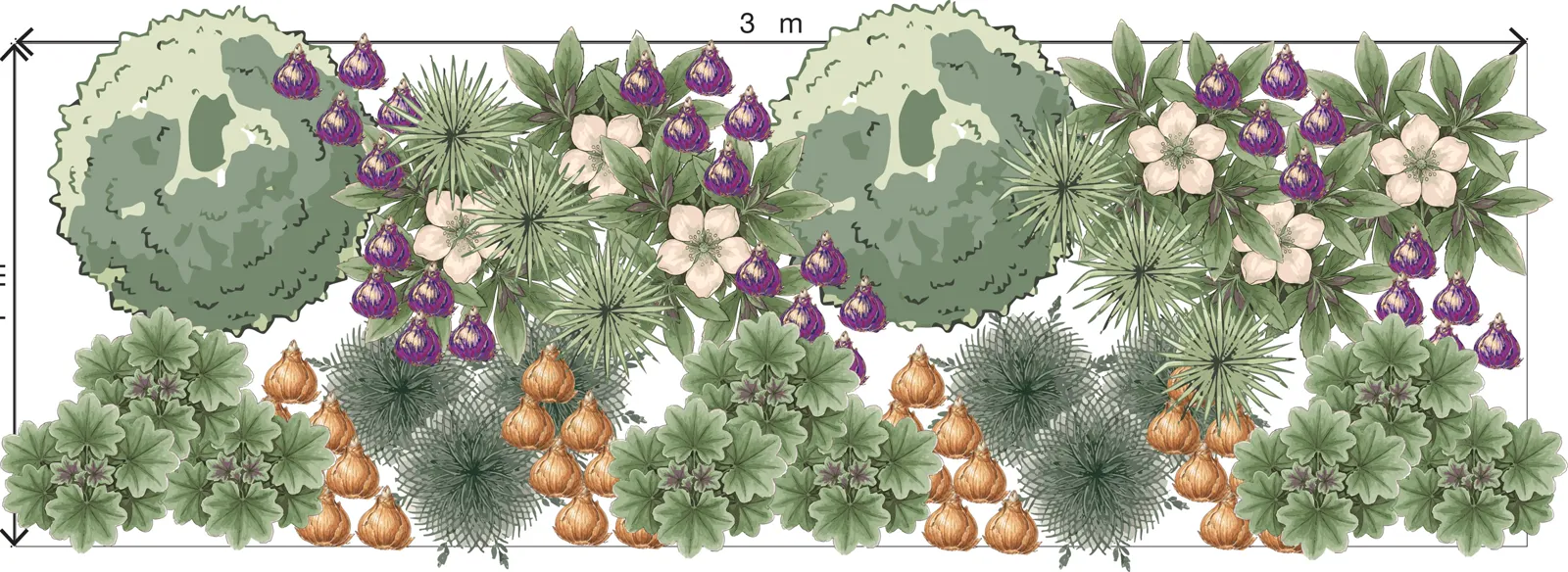
How the bed works
- The frame comes first Sedge, hellebore and Veronica keep their leaves all year, and foamflower carpets the front from spring to autumn, so the bed never looks bare.
- Flowers arrive in waves Hellebore, then dog's tooth violet, then foamflower with blue camassia, then iris. Veronica carries on through summer.
- Bulbs in ribbons, not dots Each bulb drift is a loose diagonal ribbon tucked among the front plants, denser in the middle and thinner at the ends.
- Space to full spread Every plant is spaced at its full mature spread, so the bed fills in without crowding.
The plants
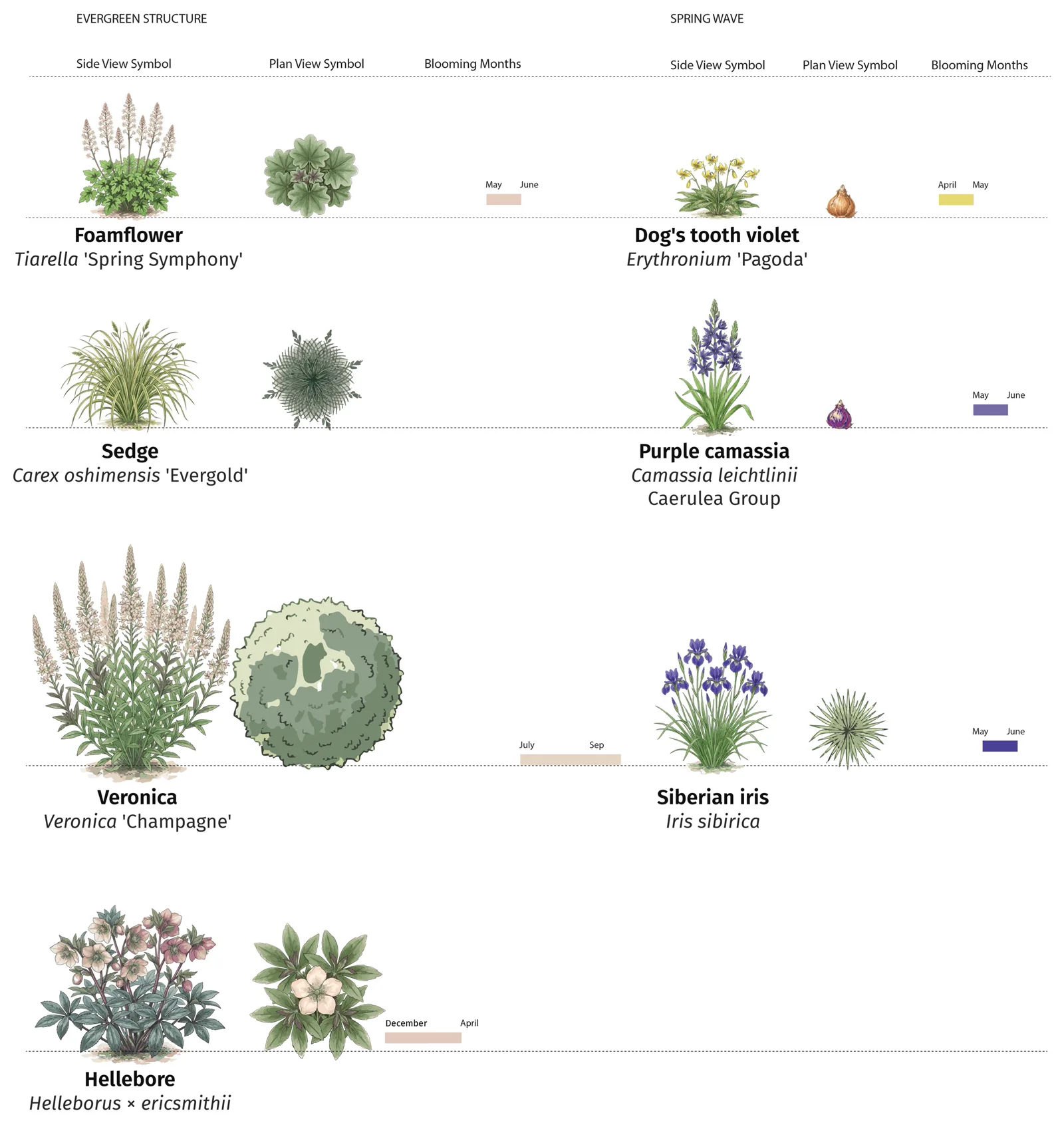
Plant list
| Group | Plant | Number | Flowers | Height | Spread | Planting gap | Leaves |
|---|---|---|---|---|---|---|---|
| Frame | Foamflower Tiarella 'Spring Symphony' | 9 | May–Jun | 30cm | 30cm | 30cm | Spring–autumn |
| Frame | Sedge Carex oshimensis 'Evergold' | 6 | Grown for leaves | 30cm | 30cm | 30cm | Evergreen |
| Frame | Hellebore Helleborus × ericsmithii | 6 | Dec–Apr | 45cm | 40cm | 40cm* | Evergreen |
| Frame | Veronica (shrubby veronica, hebe) Veronica 'Champagne' | 2 | Jul–Sep | 60cm | 60cm | 60cm | Evergreen |
| Spring wave | Dog's tooth violet Erythronium 'Pagoda' | 28 bulbs | Apr–May | 35cm | – | 10cm | Dies back in summer |
| Spring wave | Purple camassia Camassia leichtlinii Caerulea Group | 30 bulbs | May–Jun | 1.3m | – | 10cm | Dies back in summer |
| Spring wave | Siberian iris Iris sibirica | 6 | May–Jun | 1.2m | 30cm | 30cm | Dies back in winter |
Frame
- Plant
- Foamflower Tiarella 'Spring Symphony'
- Number
- 9
- Flowers
- May–Jun
- Height
- 30cm
- Spread
- 30cm
- Planting gap
- 30cm
- Leaves
- Spring–autumn
Frame
- Plant
- Sedge Carex oshimensis 'Evergold'
- Number
- 6
- Flowers
- Grown for leaves
- Height
- 30cm
- Spread
- 30cm
- Planting gap
- 30cm
- Leaves
- Evergreen
Frame
- Plant
- Hellebore Helleborus × ericsmithii
- Number
- 6
- Flowers
- Dec–Apr
- Height
- 45cm
- Spread
- 40cm
- Planting gap
- 40cm*
- Leaves
- Evergreen
Frame
- Plant
- Veronica (shrubby veronica, hebe) Veronica 'Champagne'
- Number
- 2
- Flowers
- Jul–Sep
- Height
- 60cm
- Spread
- 60cm
- Planting gap
- 60cm
- Leaves
- Evergreen
Spring wave
- Plant
- Dog's tooth violet Erythronium 'Pagoda'
- Number
- 28 bulbs
- Flowers
- Apr–May
- Height
- 35cm
- Spread
- –
- Planting gap
- 10cm
- Leaves
- Dies back in summer
Spring wave
- Plant
- Purple camassia Camassia leichtlinii Caerulea Group
- Number
- 30 bulbs
- Flowers
- May–Jun
- Height
- 1.3m
- Spread
- –
- Planting gap
- 10cm
- Leaves
- Dies back in summer
Spring wave
- Plant
- Siberian iris Iris sibirica
- Number
- 6
- Flowers
- May–Jun
- Height
- 1.2m
- Spread
- 30cm
- Planting gap
- 30cm
- Leaves
- Dies back in winter
Notes
- Prepare the bed first. Dig in plenty of compost or leaf mould before planting, so the soil is humus-rich, holding moisture but never waterlogged.
- Give Veronica the brightest, best-drained spot in the bed (RHS).
- Water everything regularly in the first year until the roots establish.
The waves: what flowers when
The frame keeps its leaves while the flowers take turns. The coloured bars show flowering months; the thin green line shows leaves that stay all year.
- Leaves all year
- Flowers (colour shows flower colour)
- Wave 1 · Dec–Apr Hellebores open first, with pale greenish-pink flowers over evergreen leaves.
- Wave 2 · Apr–May As the hellebores fade, the yellow dog's tooth violets nod above mottled leaves.
- Wave 3 · May–Jun Tall blue camassia spikes rise over a froth of white foamflower.
- Wave 4 · late May–Jun Siberian irises take over from the camassia, often overlapping for a week or two.
- Summer · Jul–Sep Veronica 'Champagne' flowers white, and the sedge and foamflower keep the front full and green.
When and how to plant
| When | What to plant |
|---|---|
| Autumn (Sep–Nov) | Dog's tooth violet: plant as soon as you get the bulbs, ideally early in autumn. Set them 10cm deep and 10cm apart. Never let the bulbs dry out: keep them slightly damp until planting and water them in. Camassia: plant from September to November, pointed end up, at least 10–15cm deep (about twice the height of the bulb) and 10cm apart. Water in well. Hellebore: plant any time from autumn to spring, avoiding dry summer months. Choose the most sheltered part of the bed. Siberian iris (potted): plant from March to mid-November. |
| Spring (Apr–May) | Veronica: plant in April or May, when the soil is warming up. Never plant it in winter, when young plants are prone to rotting. Foamflower and sedge: plant in late spring (May), in among the bulbs as they flower, so you can see where they are. |
Autumn (Sep–Nov)
- What to plant
- Dog's tooth violet: plant as soon as you get the bulbs, ideally early in autumn. Set them 10cm deep and 10cm apart. Never let the bulbs dry out: keep them slightly damp until planting and water them in. Camassia: plant from September to November, pointed end up, at least 10–15cm deep (about twice the height of the bulb) and 10cm apart. Water in well. Hellebore: plant any time from autumn to spring, avoiding dry summer months. Choose the most sheltered part of the bed. Siberian iris (potted): plant from March to mid-November.
Spring (Apr–May)
- What to plant
- Veronica: plant in April or May, when the soil is warming up. Never plant it in winter, when young plants are prone to rotting. Foamflower and sedge: plant in late spring (May), in among the bulbs as they flower, so you can see where they are.
Planting the bulb ribbons
- Mark each ribbon on the soil with sand or a cane: a loose diagonal about 60–70cm long and 20–25cm wide, running between the front plants.
- Lay the bulbs out on the surface first, about 10cm apart. Set them closer together in the middle of the ribbon and fewer towards the ends, so each drift tapers off naturally.
- Plant each bulb at its depth (10cm for dog's tooth violet, 10–15cm for camassia) and water the whole ribbon in.
- Push in a label or short cane at each end of every ribbon, so you don't dig into the bulbs when you plant the rest of the bed in spring.
Planting the frame
- Set out all the pots on the plan first, spacing each plant at its planting gap.
- Plant at the same depth as the pot and firm in gently.
- Water well, then keep the soil moist through the first summer.
Simple care, month by month
Hellebore
- Dec–Jan: as the buds appear, pick off any old, tatty or spotted leaves at the base so the flowers show. Leave the healthy leaves: this hellebore flowers on leafy stems.
- May: once the flowers have faded and the seed has dropped, cut the old flower stems to the base and remove ageing leaves. New shoots will grow from the base.
- Oct–Nov: remove any damaged leaves and mulch around the plant. Don't divide it: hellebores dislike being moved.
Veronica 'Champagne'
- Apr: after a harsh winter, cut out any winter-damaged shoots.
- Jul–Sep: snip off the flower spikes as they fade to keep it tidy and flowering.
- Sep: if it needs shaping, lightly clip it over with shears after flowering. Never cut back into the bare woody stems, because it rarely regrows from them.
Foamflower
- Mar–Apr: remove dead or damaged leaves to make way for new growth.
- Jun–Jul: trim back lightly after flowering.
- Every few years: divide crowded clumps in spring or in Sep–Nov. Watch for slugs.
Siberian iris
- Jun–Jul: after flowering, cut the flower stems down to where they meet the leaves.
- Oct–Nov: cut the dying leaves down close to the ground.
- When the centre flowers less: divide straight after flowering or in Aug–Sep. Lift the clump, split it with two forks back to back, keep large outer pieces and replant at the same depth.
Sedge
- Feb–Mar: comb through the clump with gloved fingers to pull out dead leaves.
- Jun–Aug: cut out any dead leaves that are left. Don't cut the whole clump back.
Bulbs
- After flowering: cut off the faded camassia spikes before they seed, as camassia can self-seed heavily.
- May–Jul: leave all the bulb leaves to die back naturally (at least six weeks) so they feed next year's flowers. Remove them only once they're yellow and limp.
Mulch and water
- Oct–Nov: spread a 5–7cm mulch of leaf mould or garden compost over the bed, keeping it just clear of the plant crowns and the Veronica's stems. It holds moisture for the bulbs, feeds the soil and protects the hellebores over winter.
- Spring–summer: water in dry spells, especially in the first year. Dog's tooth violets must never dry out.
Plant facts from RHS (rhs.org.uk) and BBC Gardeners' World (gardenersworld.com). Planting plans and quantities are indicative only: check your own light and soil before buying. Outside the UK? Check plants against your local invasive species list before planting.
Find plants for your own soil and light at garden-pal.com
Designed by SD Landscapes · sdlandscapes.uk · @sd.landscapes.studio · Illustrations: Shoshan Dagan / Garden Pal
Find plants like these for your own soil and light
Free to start. Add your garden and Garden Pal matches plants to your soil, light, and climate.
Planting advice here is written for UK conditions. Some of these plants are invasive or weedy in other countries, so check your local invasive plant list before planting.
Find plants like these for your own soil and light
Free to start. Add your garden and Garden Pal matches plants to your soil, light, and climate.
Download the free illustrated plan (PDF)
Create a free Garden Pal account to save the illustrated plan to your phone.